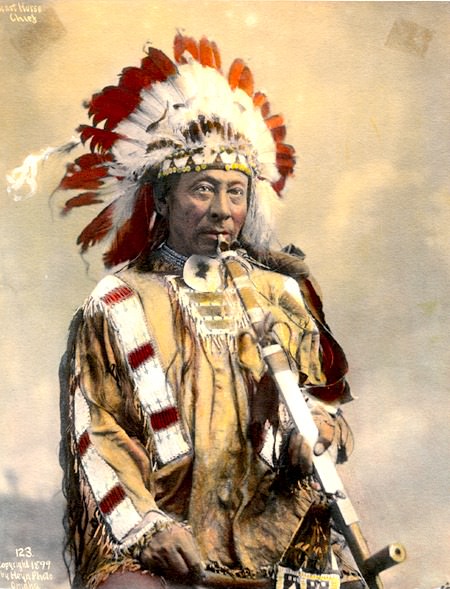
Chief Fast Horse is presented in a carefully posed studio portrait credited to Heyn, dated 1899, and later colorized to bring new immediacy to the scene. The soft, clouded backdrop keeps attention on the sitter’s steady gaze and the crisp silhouette of a large feathered headdress, whose red and white tones stand out against neutral browns and creams. Colorization here doesn’t rewrite the past so much as it highlights texture—feathers, beadwork, and cloth—details that monochrome often flattens.
At the center, the Lakota leader holds a long ceremonial pipe, its pale stem and darker bowl forming a strong vertical line that anchors the composition. The beaded band across the forehead and the layered garments suggest both personal status and the importance of regalia in conveying identity, responsibility, and community ties. Subtle wear in the clothing and the natural set of the hands keep the portrait from feeling purely theatrical, reminding viewers that studio photography was a meeting point between lived tradition and the era’s commercial image-making.
Behind the formal pose lies the broader context of late 19th-century Native American photography, when portraits were frequently shaped by outside expectations while still preserving unmistakable individuality. For readers searching terms like “Lakota chief portrait,” “Heyn photograph,” or “1899 Native American photo colorization,” this image offers a striking example of how Indigenous presence was recorded and circulated at the time. The result is a compelling historical photo that invites closer looking—both at what the camera emphasized and at what the subject chose to present.