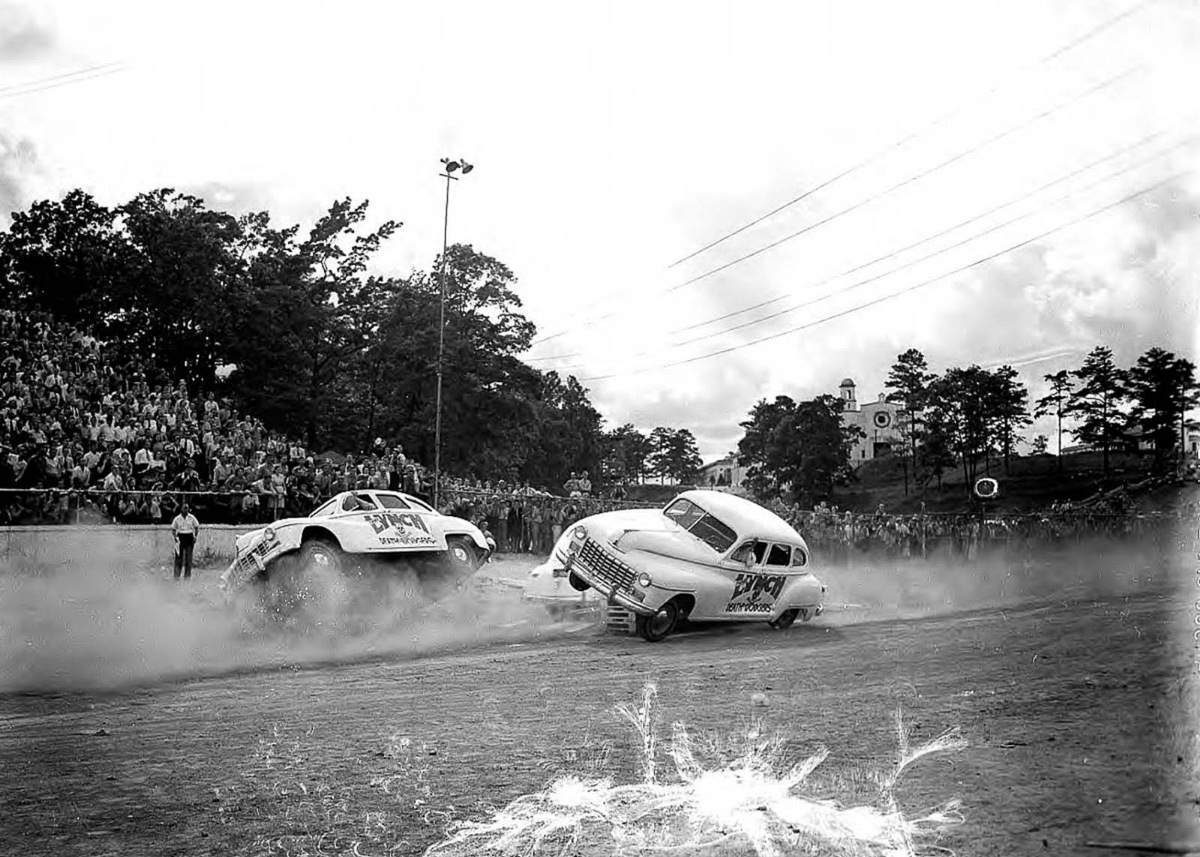
Dust hangs low over a packed arena as two cars collide and tilt at improbable angles, the kind of choreographed chaos that made Jimmie Lynch and his Death Dodgers a name whispered with equal parts thrill and dread. In the foreground, one vehicle rides up and over a barrier or ramp while another skids sideways, tires biting into the dirt and throwing debris into the air. The grandstand crowd forms a dense wall of faces behind a simple fence, proof that auto-stunt shows were mass entertainment in the 1940s sports scene.
On the side of a car, bold lettering appears to read “Lynch,” a small detail that anchors the action to the troupe mentioned in the title and hints at the promotional flair surrounding these performances. The setting feels like a fairground or stadium lot, with trees framing the perimeter and utility lines cutting across the sky, turning a local venue into a temporary theater of speed and risk. What looks like a circular target or hoop structure in the distance suggests the variety-act nature of these events, where precision driving, near-misses, and planned crashes were the main attraction.
Car-crash entertainment occupies a curious corner of American sporting culture, blending daredevil spectacle with the mechanical optimism of the mid-century automobile age. This historical photo freezes the split second when momentum, machinery, and showmanship meet, long before modern safety standards and televised motorsport polish. For readers interested in vintage motorsports, stunt driving history, and 1940s popular entertainment, it offers a vivid glimpse of how crowds once gathered to watch drivers flirt with disaster—by design.