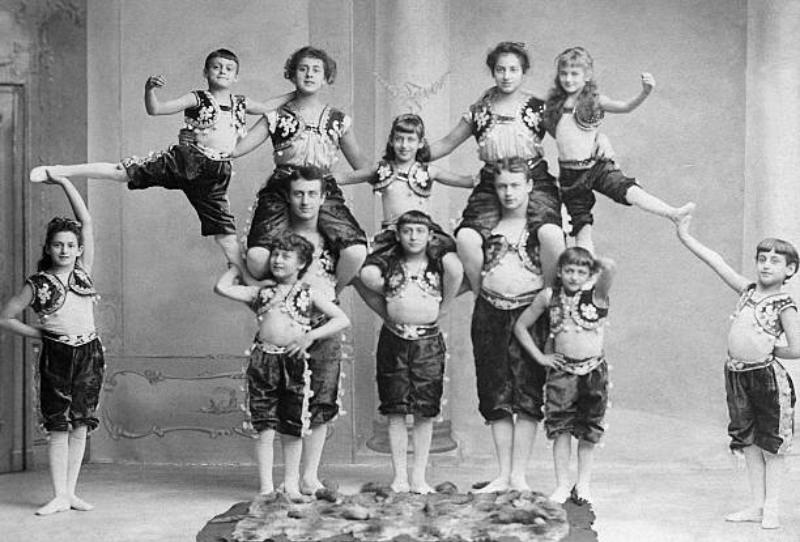
Poised in a carefully balanced tableau, the Kremos present themselves as both family and troupe, their bodies forming a living structure of strength, symmetry, and trust. The staged studio backdrop and theatrical costumes suggest a professional act meant to travel and to be remembered, with each performer holding a crisp pose that reads clearly even at a glance. It’s a portrait designed to sell skill: controlled lifts, outstretched legs, and the quiet confidence of people used to working in perfect coordination.
Two adult men anchor the center while younger performers climb, brace, and extend from their shoulders, turning kinship into choreography. The matching outfits—decorative tops and loose shorts—signal a unified brand, the sort of visual identity that helped acrobatic families stand out on posters and in programs during the late 19th and early 20th centuries. Faces remain composed rather than playful, emphasizing discipline over spectacle and hinting at the rigorous training behind what looks effortless.
Across Switzerland and beyond, family acrobatics thrived on continuity: children learned early, routines evolved, and a name could become a legacy across generations. This photo invites a closer look at how entertainment history was built not only in grand circuses and music halls, but also in the everyday reality of relatives depending on one another—literally—for balance. For readers interested in circus history, physical culture, and European performance traditions, the Kremos offer a striking example of how athletic artistry and family life intertwined on stage.