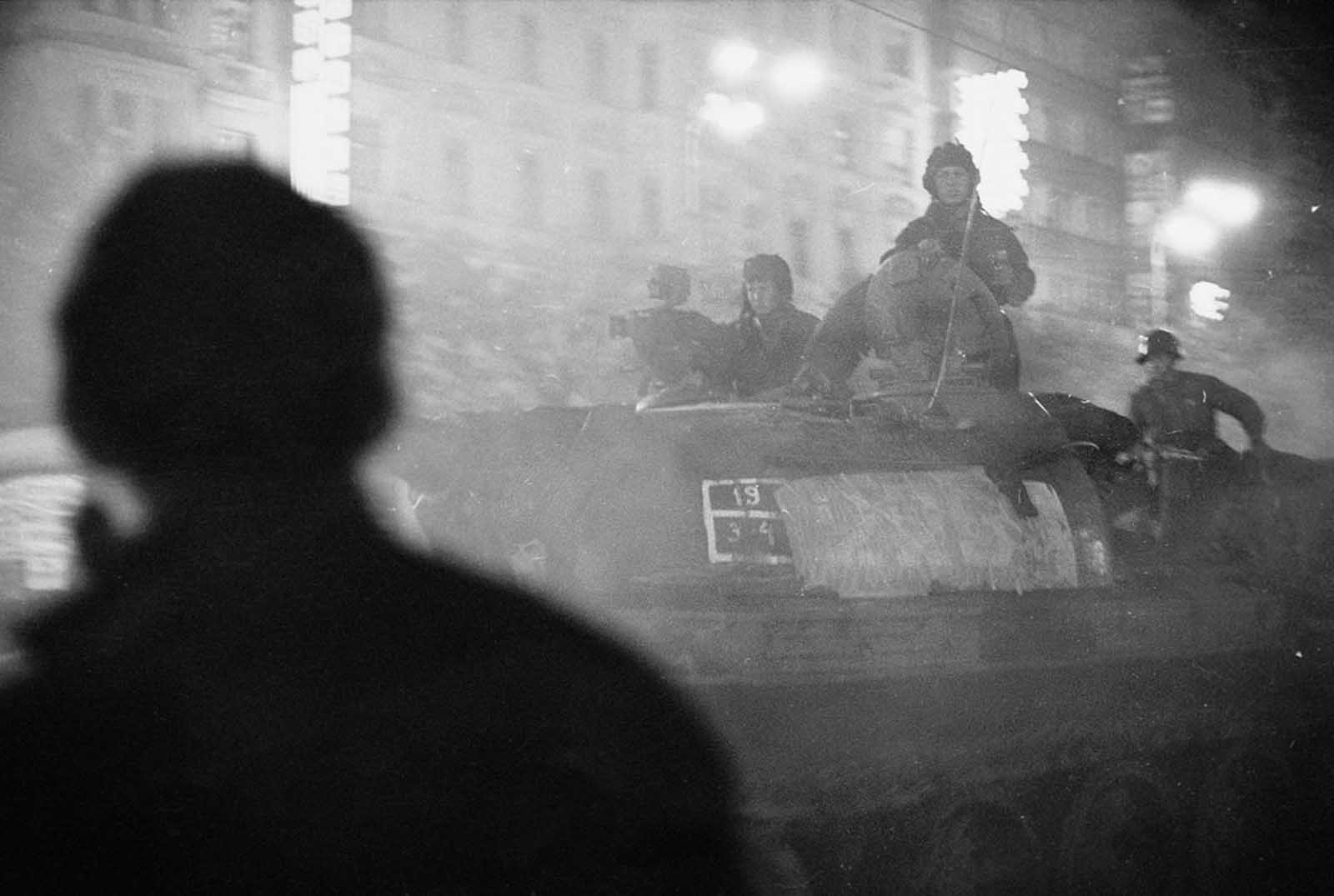
A lone onlooker, reduced to a dark silhouette in the foreground, stands as Soviet tanks roll forward through Prague after nightfall in August 1968. Streetlights and glowing shop signs blur into a hazy backdrop, while the armored vehicle’s hard lines and mounted soldiers emerge from the smoke and glare. The composition turns the viewer into a witness, sharing the same uneasy distance as the figure who watches without intervening.
Night amplifies everything here: the clatter of tracks seems implied by the grit of the scene, and the air looks thick with exhaust, dust, or tearful mist caught by the lens. Soldiers ride high atop the tank, bundled against the darkness, scanning the street ahead as if expecting resistance at any corner. Prague’s urban facades fade into ghostly shapes, emphasizing how quickly ordinary streets can become corridors of occupation.
Seen through the frame of Cold War history, the image evokes the tense aftermath of the Prague Spring and the Warsaw Pact invasion that followed. It also fits the post’s broader theme of civil conflict and contested power, where fear, uncertainty, and muted defiance live side by side. For readers searching for photographs of the 1968 Prague invasion, Soviet tanks in the streets, or nighttime scenes of military occupation, this haunting moment preserves the human scale of a political earthquake.