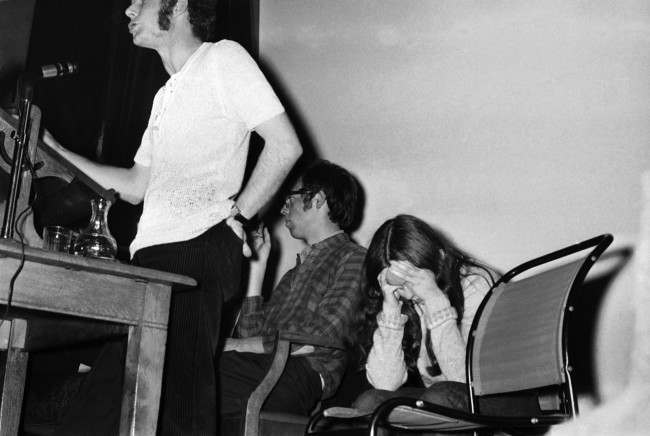
Bernadette Devlin stands at a lectern with a microphone, caught mid-speech in a packed academic setting after her 48-hour vigil outside No. 10 Downing Street. The angle keeps the focus on the intensity of public address—papers close at hand, a glass on the table, and the speaker’s posture turned toward an unseen audience. In the title’s context of Oct. 20, 1971, the moment reads as a deliberate shift from street-level protest to institutional debate at the London School of Economics.
Along the edge of the frame, the room’s emotional temperature is just as telling as the political headline. A seated listener leans back as if absorbing the argument, while another bows forward with hands to her face, suggesting fatigue, distress, or the strain of listening to hard truths. These small human details ground the larger story of Northern Ireland, Westminster politics, and the pressure placed on figures who tried to bridge activism and parliamentary power.
Framed as “Civil Wars,” the photograph works both as documentary evidence and as atmosphere: the muted tones, stark lighting, and tight composition underline a period when public life felt urgent and personal. Readers searching for Bernadette Devlin, Mid-Ulster, Downing Street protest, or the London School of Economics in 1971 will find in this image a vivid reminder of how political conflict played out in lecture halls as well as on the pavement. It’s a snapshot of activism in transit—between vigil and speech, exhaustion and resolve, private emotion and public argument.