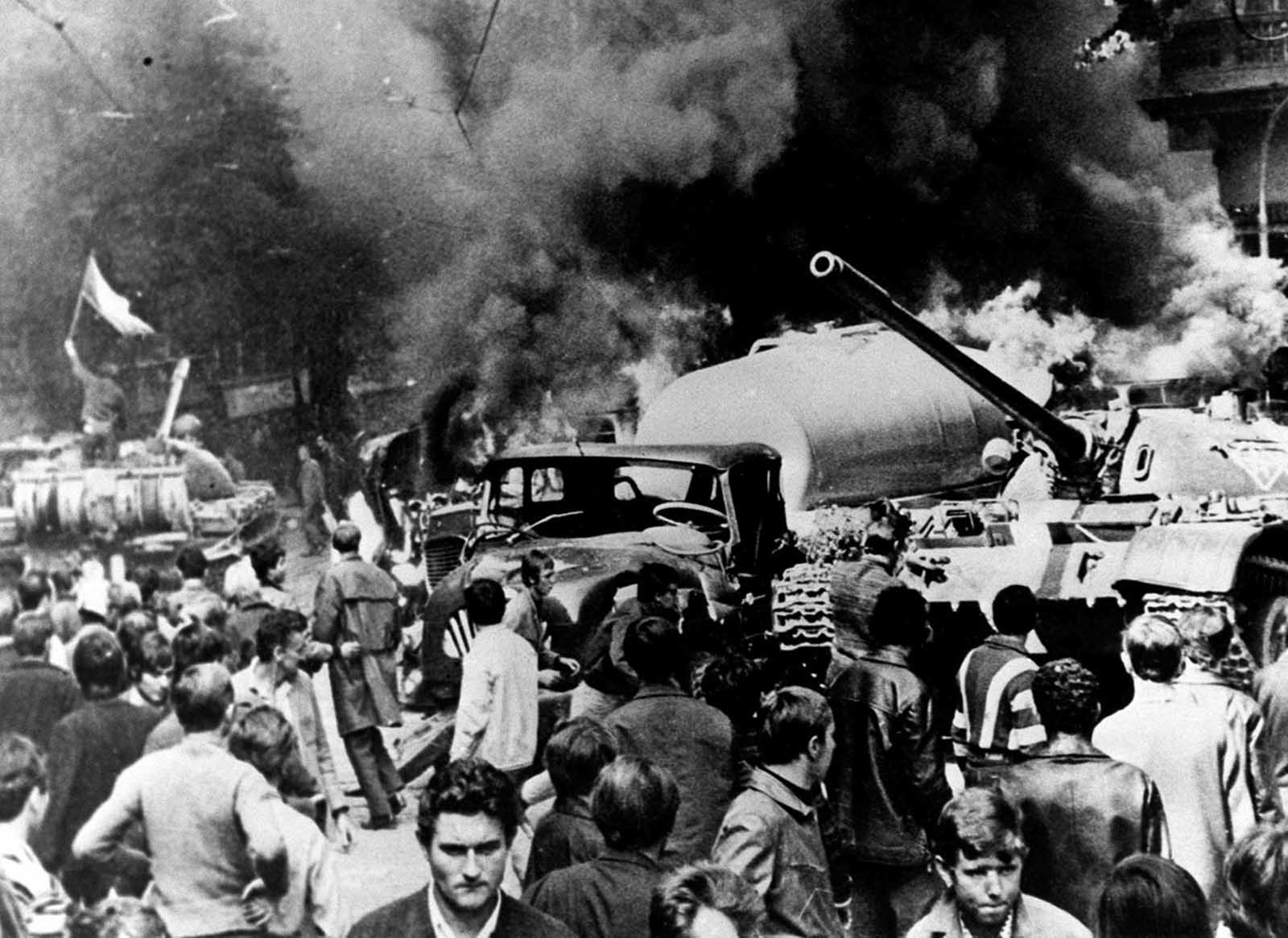
Smoke rolls across a crowded Prague street as armored vehicles push into view, their hard angles cutting through the chaos. A Soviet tank dominates the foreground, while behind it burned-out cars and trucks sit gutted and blackened, still giving off thick plumes that swallow the background. Packed tightly together, onlookers and passersby fill the frame, their faces turned toward the flames and steel with an uneasy mix of anger, shock, and wary attention.
August 21, 1968 marked the moment Soviet troops entered the Czechoslovakian capital, and the photograph’s details underline how quickly a city can be transformed into a contested stage. The wreckage suggests street-level confrontation—vehicles stopped, set alight, or destroyed—while the crowd’s proximity hints at civilians refusing to vanish from their own public spaces. Even without hearing the noise, the scene reads as loud: engines, shouting, crackling fire, and the tense silence that follows when power arrives on treads.
As a historical record of the Prague Spring’s violent interruption, this image carries the visual vocabulary of Cold War crisis—tanks in city streets, civilian resistance, and the bleak geometry of occupation. For readers searching for Prague 1968, Warsaw Pact invasion photographs, or eyewitness scenes from the Soviet intervention in Czechoslovakia, it offers a stark, immediate window into that day. The sullen faces in the crowd are as important as the armored hulls: they remind us that political decisions are lived at street level, in smoke, fear, and defiance.