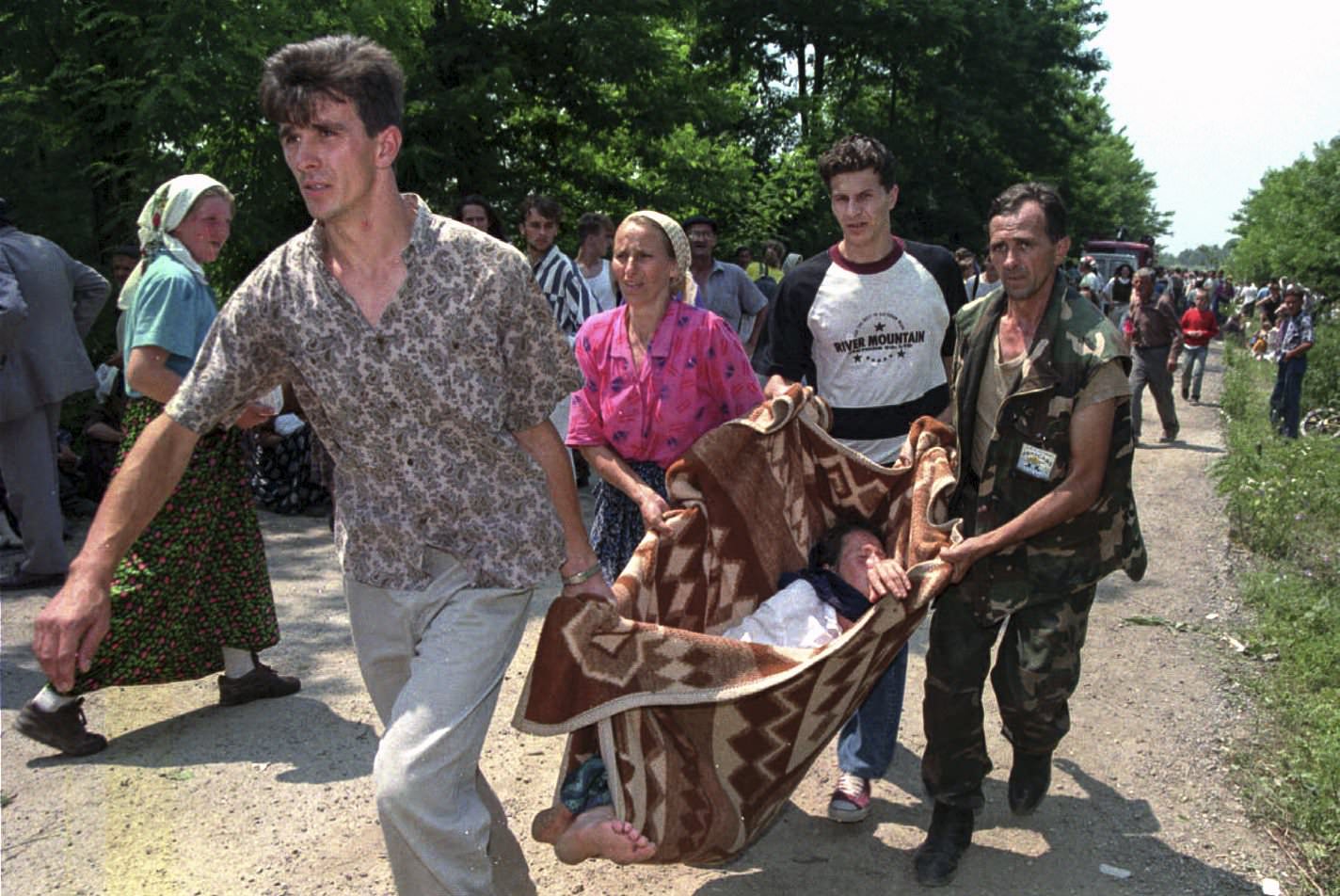
Dust rises from a narrow road lined with summer trees as a small group moves with urgency, gripping the corners of a patterned blanket used as a makeshift stretcher. A sick woman lies cradled in the fabric, her bare feet visible, while refugees and a Bosnian government soldier keep pace through a crowd that stretches into the distance. Faces nearby—women in headscarves, men watching with tight expressions—suggest a community on the move, drawn toward the promise of care and relative safety.
Set outside Tuzla on July 13, 1995, the scene reflects the harsh improvisation of the Bosnian War, when civilians often depended on whatever could be carried, shared, or stitched together in the moment. The soldier’s camouflage and the civilians’ everyday clothing meet in a single task: getting one vulnerable person to a hospital inside a U.N. base. That convergence—military presence, displaced families, and international protection—captures the complicated geography of refuge during civil wars, where a checkpoint or compound could mean the difference between life and death.
What lingers is not only the suffering but the coordination: hands tightened on cloth, eyes scanning ahead, bodies leaning into a common rhythm. The image speaks to humanitarian corridors and the fragile routines of emergency medicine under siege, when a blanket becomes a stretcher and strangers become a rescue team. For readers searching the history of Tuzla, U.N. bases in Bosnia, and the human experience of refugees in 1995, this photograph offers a stark, intimate doorway into that larger story.