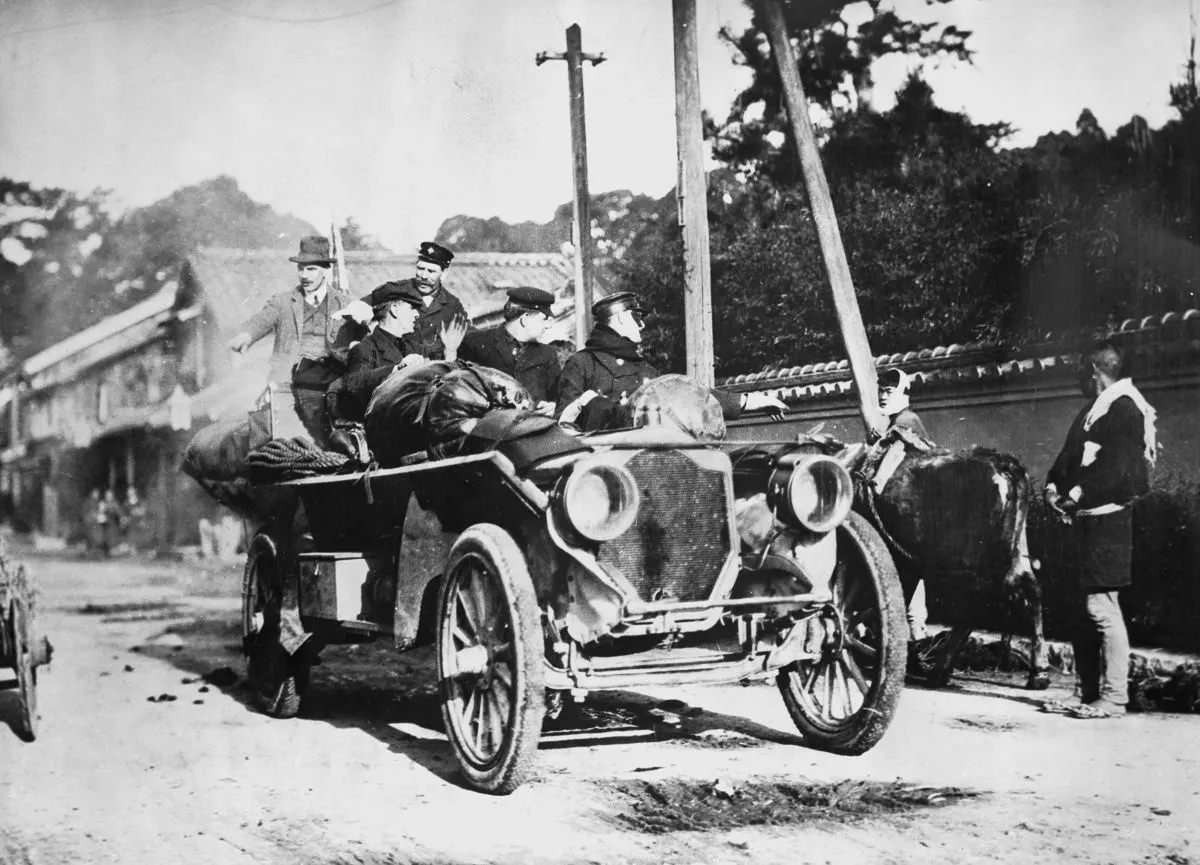
Bouncing along a rough, rutted roadway, the American Thomas Flyer rolls into Kobe with its lamps forward and its chassis packed for endurance—bags lashed down, tools close at hand, and the crew riding exposed to the elements. The setting feels unmistakably Japanese, with tiled roofs and roadside figures framing the moment as the race machine threads through everyday city life. For readers searching Great New York to Paris Auto Race images, few scenes convey the sheer improvisation of early motor travel as vividly as this street-level encounter.
Uniformed men cluster around the car as if guiding it through traffic or clearing a path, while onlookers watch from the roadside with the cautious curiosity reserved for unfamiliar technology. The Thomas Flyer’s high wheels and open body speak to a world before paved highways, when dust, mud, and broken surfaces were part of the contest as much as speed. In a single frame, the photograph captures the intersection of motorsport, logistics, and local order—an instant where an international race meets a working city.
What makes this Kobe passage so compelling is its reminder that the 1908 New York to Paris race was never just a duel between drivers; it was a moving negotiation with terrain, weather, and communities along the route. The photo’s details—telegraph poles, roadside walls, and the close proximity of pedestrians—place the car within the lived geography of the time rather than a closed course. As a historical sports image and a snapshot of early automotive culture in Japan, it offers a grounded view of how global spectacle traveled on ordinary roads.