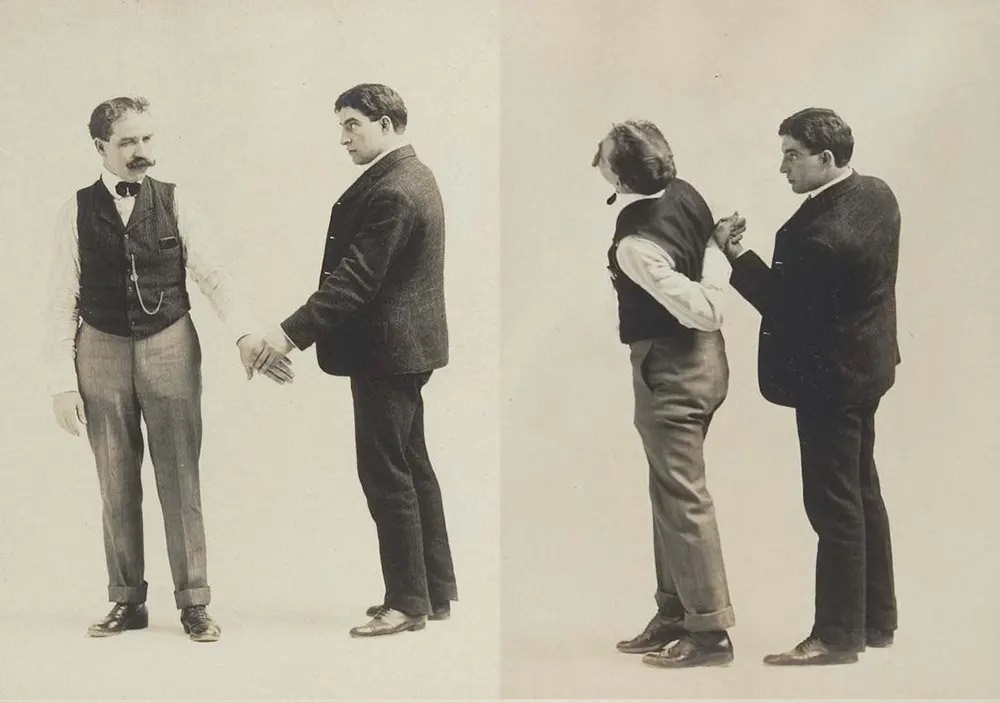
Gentlemen in waistcoats and tailored suits stand against a plain studio backdrop, their calm expressions contrasting with the tension in their hands. One pairing begins with what looks like a casual grasp at the wrist, posed like a social interaction turned suddenly instructional. Every crease of fabric and polished shoe grounds the lesson in the everyday Victorian wardrobe, a reminder that “self-defense” was often taught for streets and salons, not just for the training hall.
Across the frame, the sequence shifts into a firmer restraint, with an arm pinned behind the back in a controlled hold. The men demonstrate the maneuver with an almost theatrical clarity—bodies angled for the camera, feet placed deliberately, shoulders squared—so the viewer can read the technique step by step. Even without captions visible here, the staging suggests a printed guide meant to be studied, practiced, and perhaps debated as part of the era’s growing interest in practical athletics and personal safety.
As a 1895 sports-themed self-defense guide, this historical image sits at the crossroads of Victorian etiquette and emerging martial instruction. It offers a fascinating look at how late-19th-century manuals used photography to translate movement into knowledge, presenting “maneuvers” as both science and spectacle. For collectors, researchers, and martial arts historians, the photo is a crisp window into period training culture—formal, methodical, and surprisingly modern in its desire to teach through visual demonstration.