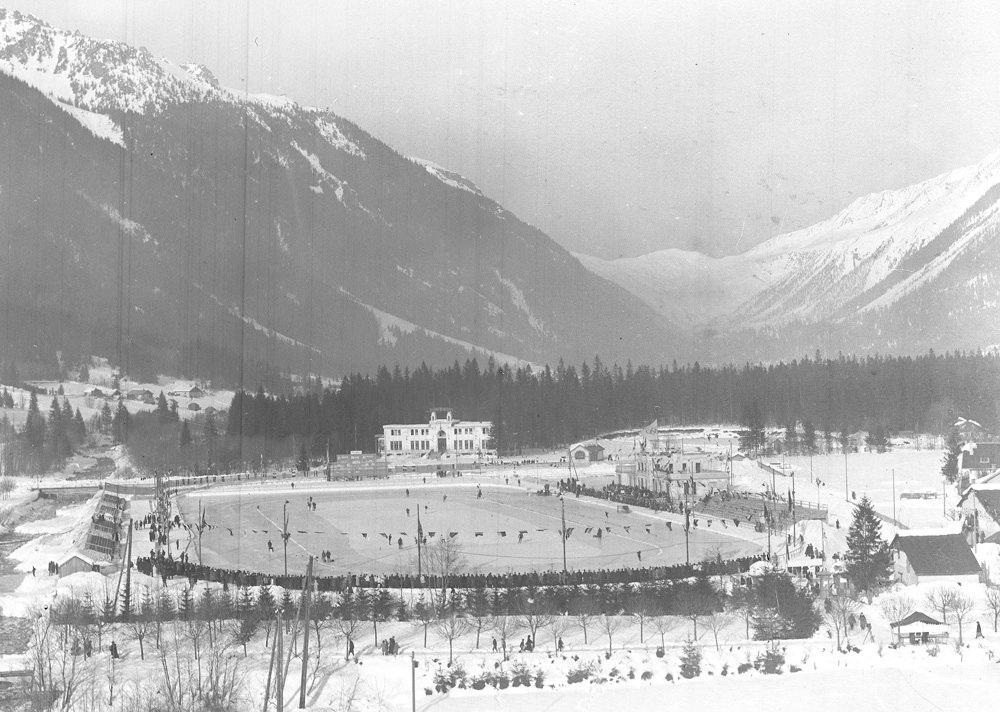
Nestled in the shadow of the Alps, the Olympic Stadium at Chamonix appears as a broad oval carved into a snowbound valley, its white infield ringed by dark bands of spectators. Mountains rise steeply behind the venue, and a line of trees frames the scene, emphasizing how closely early Winter Olympic sport was tied to the natural landscape. Even at a distance, the geometry of the track and the scattered figures on the ice suggest a place built for speed, endurance, and pageantry.
Across the perimeter, simple grandstands and fence lines hold back the crowd, while strings of flags add a celebratory rhythm to the cold air. A prominent building stands beyond the track, anchoring the stadium complex and hinting at the logistical effort required for an international event in an alpine town. The photo’s wide viewpoint invites the eye to travel from the activity on the field to the surrounding slopes, where winter looks less like a backdrop and more like a participant.
For anyone exploring the history of the first Winter Olympics, this 1924 view offers a vivid reminder of how the Games once looked before modern arenas and massive infrastructure. Chamonix, France comes through as both intimate and grand—an outdoor stadium where spectators watched events against a horizon of snow peaks. It’s an enduring snapshot of early Olympic tradition, alpine sports culture, and the origins of winter competition on a world stage.