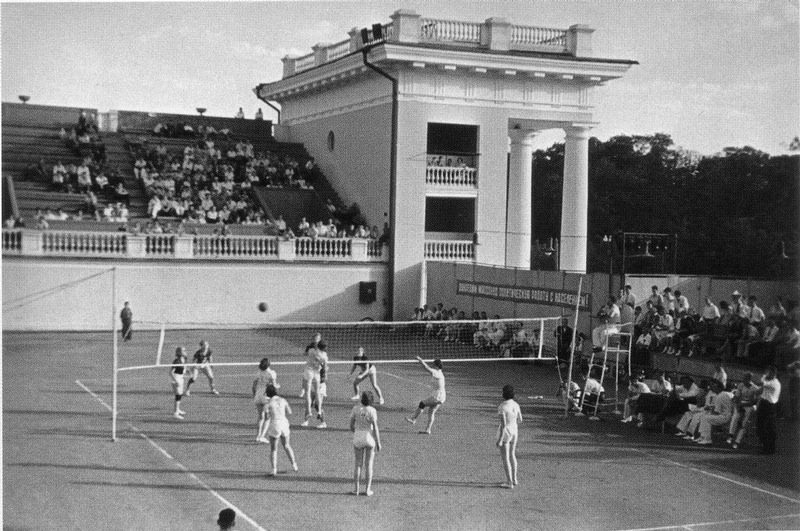
Across a broad outdoor court, a women’s volleyball match unfolds under the gaze of packed stadium benches, with a classical pavilion and tall columns rising behind the play. The athletes in light uniforms spread across the sanded surface, knees bent and arms poised, as the ball hangs mid-flight above the net. In the stands and along the sideline, spectators cluster close, turning a routine rally into a public event.
The scene fits the post’s theme of “Strong Bodies, Strong Will,” where 1930s Soviet sport culture celebrated discipline, coordination, and collective effort. Team sports like volleyball offered a visible stage for women’s athletic training, presenting strength and agility not as exceptions but as ideals to be cultivated. Even without captions or identifiable names, the photograph communicates the era’s emphasis on organized physical culture and the shared rhythm of group competition.
For readers searching vintage Soviet sports photos, women athletes in the USSR, or 1930s volleyball history, this image provides a grounded, human snapshot of the time. It invites attention to details—the referee stand, the tight sideline crowd, the grandstand architecture—that frame the game as both recreation and spectacle. More than a simple “sports” moment, it’s a window into how public life, architecture, and women’s athletics intersected in an earlier century.