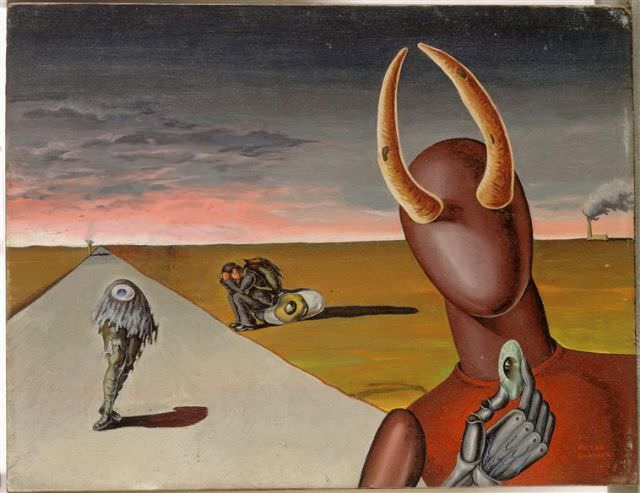
A long, pale roadway slices through a flat landscape under a darkening sky, pulling the eye toward a distant, low horizon. In the foreground, an imposing horned figure turns slightly away, its smooth, mask-like head and metallic hand catching the last warmth of the scene. The mood feels suspended between dream and warning, with the title “The Last Trip, 1937” nudging the viewer toward a sense of departure that may be final.
Along that road, a lone walker appears bundled and burdened, moving into the open space as if drawn by obligation rather than choice. Off to the side, another figure crouches beside scattered objects, adding a note of interruption—an accident, a pause, or a moment of exhaustion—while the vast emptiness presses in around them. Far in the distance, a thin plume of smoke rises from a small structure, a quiet industrial punctuation that contrasts with the otherwise surreal stillness.
As an artwork rooted in the visual language of early twentieth-century unease, this composition reads like a travel narrative turned inward, where the journey is as psychological as it is physical. The stark geometry of the road, the strange hybridity of the foreground presence, and the spare setting together create an evocative historical image for readers interested in 1930s-era art, symbolism, and the atmosphere of the prewar years. Whether approached as a surreal allegory or a haunting travel scene, it offers rich texture for interpretation—and a lingering sense that something irreversible has just begun.