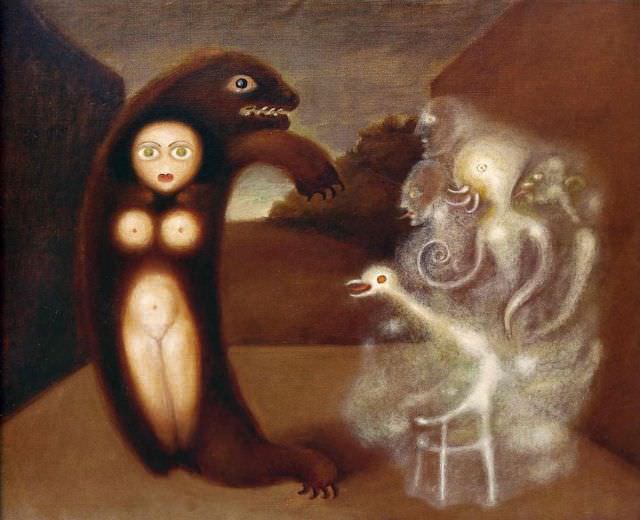
Twilight hangs over the scene in *Au Crepescule, 1938*, where a narrow path or enclosure is framed by dark, sloping walls and a muted brown sky. At the left stands a nude, wide‑eyed figure enclosed like a cutout within a heavy, animal-like silhouette, its clawed limb extended as if to shield—or claim—what it contains. The palette stays earthy and dim, lending the whole composition the hush and unease of dusk.
On the right, a pale, ghostly creature emerges in smoky whites and grays, its tentacled forms curling into the air like breath in cold light. A small, birdlike figure with an open beak faces this apparition, while a simple chair beneath it anchors the surreal encounter in the language of ordinary objects. The contrast between dense shadow and luminous haze gives the painting its tension, as though two different realities are pressing against each other at day’s end.
Surreal imagery and dream-logic drive the narrative here, making the artwork feel less like a literal story and more like an emotional landscape from the late 1930s. The title’s twilight cue invites readings about threshold moments—between safety and threat, body and mask, waking and nightmare—without pinning the viewer to a single interpretation. For collectors, students, and art-history readers searching for “Au Crepescule 1938” or exploring surrealist artworks, this piece offers a striking study in symbolism, atmosphere, and the strange theater of the subconscious.