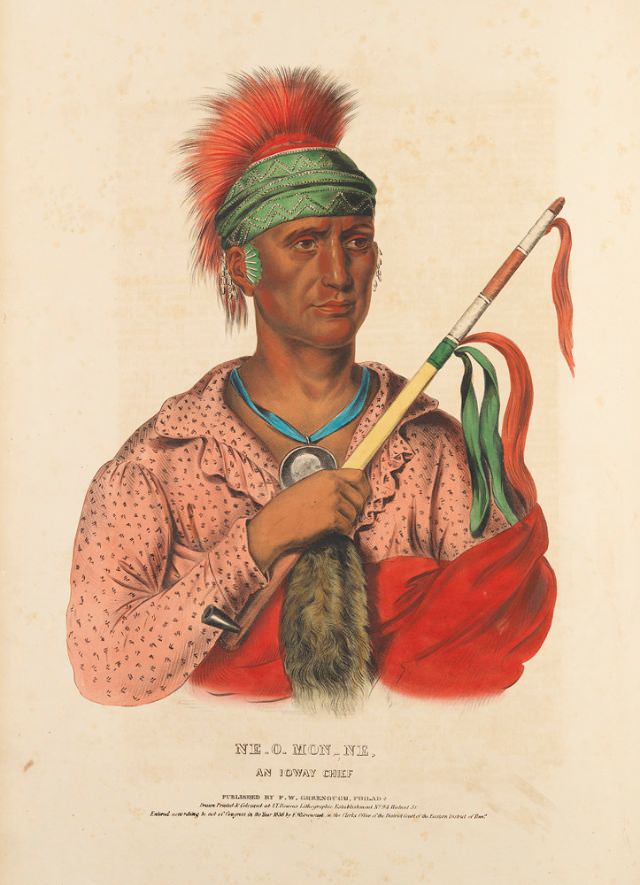
Ne-O-Mon-Ne is rendered in a formal, dignified portrait that draws the eye first to his steady gaze and then to the careful detailing of his clothing and regalia. A green patterned headband frames his face, topped with a vivid red crest of hair that adds height and motion to the composition. The artist’s warm color palette and smooth shading give the figure a sculptural presence, emphasizing both individuality and status.
Across his chest, a staff or pipe-like object is held at an angle, decorated with hanging ribbons in red and green and finished with a fur pelt, elements that signal ceremony as much as personal identity. His patterned shirt, earrings, and a round pendant at the throat are depicted with an attention that suggests the work was meant to be read as documentation as well as art. The combination of portrait realism and symbolic accessories makes this print feel like a window into how the Ioway (Iowa) were visually represented to broader audiences.
For readers searching for Native American art, Ioway history, or early portrait prints of Indigenous leaders, this image offers a compelling starting point while also raising questions about who commissioned such likenesses and how they circulated. The title, “Ne-O-Mon-Ne, An Ioway Chief,” anchors the subject plainly, inviting closer looking at the choices of pose, attire, and ornament. Viewed today, the portrait can be appreciated for its craftsmanship while also serving as a prompt to seek Ioway perspectives and context beyond the frame.