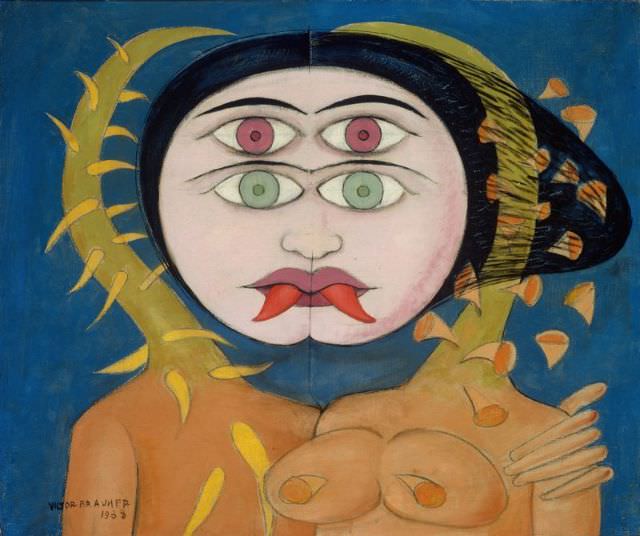
Gemini, 1938, confronts the viewer with a mask-like face that feels doubled and multiplied at once—two pairs of eyes stacked in a calm, unsettling symmetry, and lips rendered in a bold, almost theatrical red. The head is framed by sweeping dark hair, while curved, spiked forms at the left edge read like a sunburst or protective crescent, giving the composition a cosmic, zodiac-tinged aura. Even without a literal set of twins, the title’s reference to Gemini resonates in the artwork’s mirrored balance and shifting identity.
Color and line do much of the storytelling here: cool blue surrounds a warm, tan body, and scattered leaf-like shapes flicker across the figure like fragments of costume or metamorphosis. The simplified anatomy, flattened space, and emphatic outlines point to a modernist sensibility, where symbolism outweighs realism and the psyche becomes the true subject. Those layered eyes suggest multiple ways of seeing—outer and inner, waking and dreaming—while the centered face holds the composition in steady tension.
As a piece of 1930s-era art, it also sits comfortably among the decade’s fascination with the surreal, the mythic, and the psychologically charged portrait. For anyone searching for “Gemini 1938 artwork,” “surreal modernist painting,” or “zodiac-inspired art,” this image offers a striking entry point into themes of duality, transformation, and selfhood. It invites a slow look, rewarding viewers who linger over its symbols and let the title guide their interpretation.