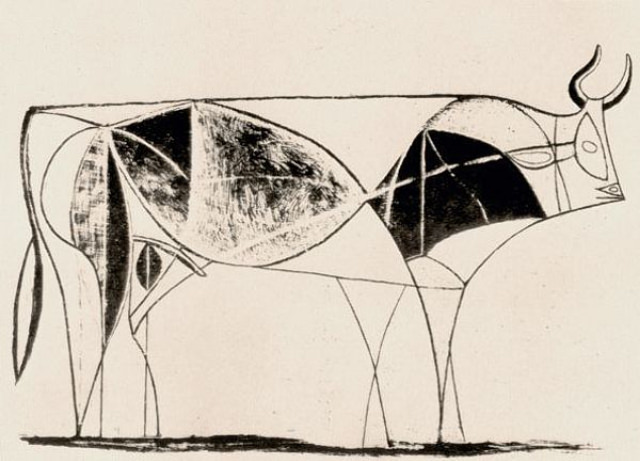
Plate 8 pushes the figure further toward economy and clarity, turning an animal into a sequence of decisive lines, intersecting planes, and carefully placed shadows. The body is stretched into a long horizontal, with bold dark passages anchoring the midsection while lighter, textured areas suggest volume without indulging in detail. Even the horns and muzzle become shorthand—just enough to signal character as the form edges closer to pure structure.
Across the torso, triangular and curved segments lock together like a constructed model, giving the composition a sense of engineering as much as observation. The legs are reduced to angular supports, their placement creating a steady rhythm beneath the simplified mass of the body. Thin contour lines and a few internal marks act like guides, tracing how the head, legs, and tail are being reconfigured to serve the overall design.
For readers interested in modernist drawing, abstraction, and the step-by-step process of reduction, this plate reads like a lesson in how representation can be rebuilt rather than merely copied. The spare background keeps attention on the transformation itself—how a recognizable creature survives through geometry, contrast, and proportion. As an artwork-focused historical reproduction, it fits naturally into discussions of line-based composition, formal experimentation, and the evolution of a motif over successive plates.