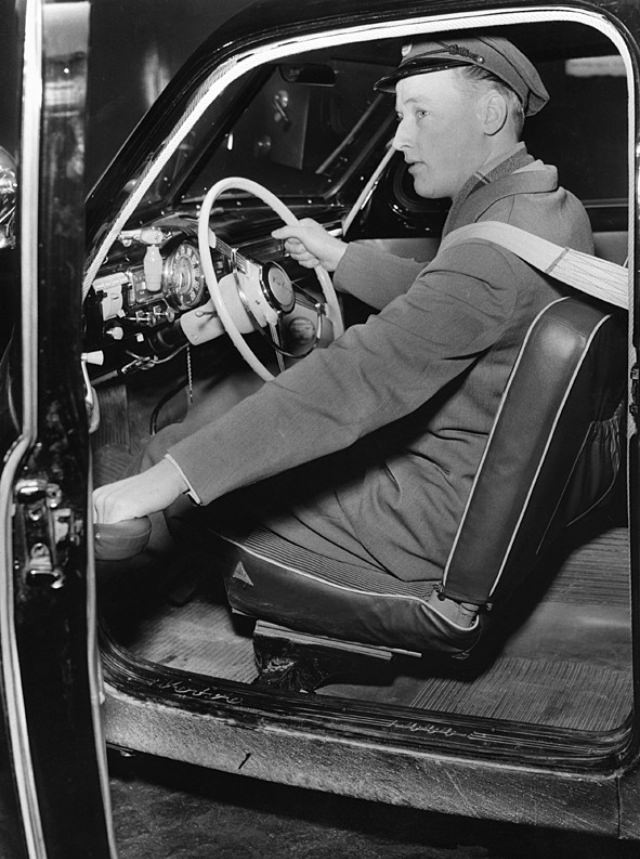
Leaning into the driver’s seat of an early Volvo, a uniformed man demonstrates a then-radical restraint: the V-shaped three-point safety belt. The strap crosses the torso and anchors low by the hip, tracing the familiar diagonal-and-lap pattern that would become standard equipment in cars around the world. Details like the wide bench-style seat, thin steering wheel, and metal dashboard controls place the scene firmly in the era when automotive safety was still finding its language.
What makes the three-point seat belt such a landmark invention is how simply it solved a complex problem—keeping the body in place during a crash while spreading force across stronger parts of the chest and pelvis. Volvo’s design married practicality with protection, improving on earlier lap belts and harnesses that were harder to use or less effective. The result was a safety breakthrough that drivers could fasten quickly and reliably, turning a piece of webbing into a life-saving habit.
For readers searching the history of car safety innovations, this photo offers a clear glimpse of the moment modern restraint systems began to feel ordinary. The “one million lives” claim tied to the Volvo three-point belt speaks to its vast real-world impact, echoed in decades of road safety research and everyday survivals that never make headlines. Seen today, the V-shaped belt is a reminder that the most important inventions aren’t always flashy—they’re the ones that quietly keep people alive.