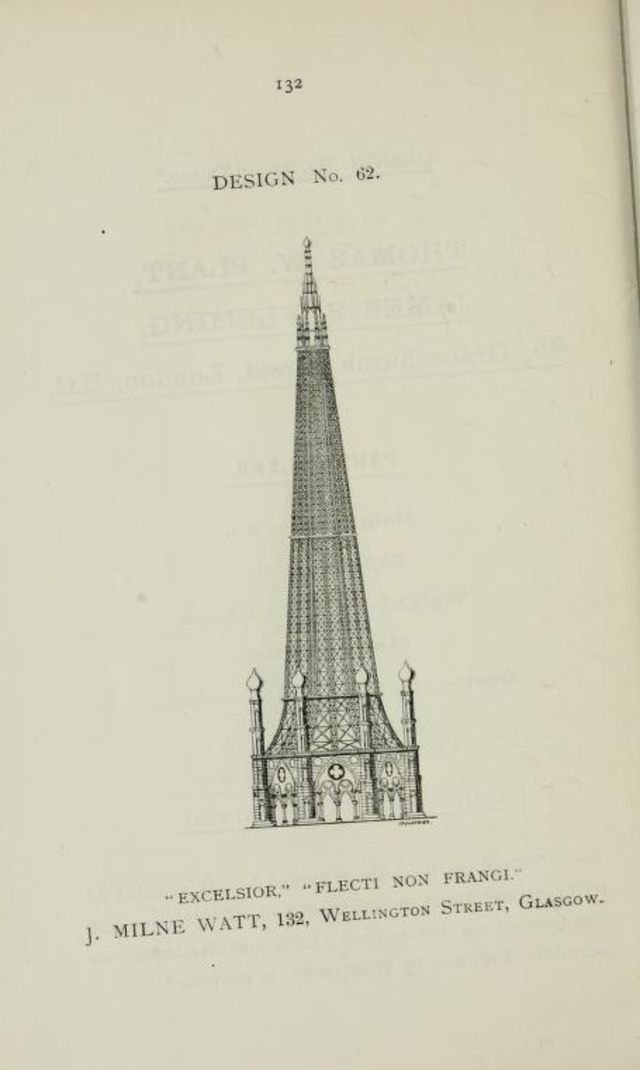
Perched on a book page marked “Design No. 62,” this slender, tapering tower proposal rises like a needle from a decorative base, hinting at the late-Victorian hunger for grand engineering statements. The drawing’s fine linework emphasizes an open lattice structure that would have looked light yet ambitious against the London skyline, while the ornate lower section—arched openings, symmetrical detailing, and small flanking turrets—suggests a desire to blend modern construction with familiar architectural ceremony.
The title’s promise of “50+ competitive designs” for a Great Tower of London in 1890 conjures an era when inventions, exhibitions, and bold public projects collided in print and in public imagination. Plans like this weren’t only about height; they were about identity, showcasing technical confidence, and offering a new landmark that could symbolize progress. Even without a built result, the surviving submissions form a rich paper trail of Victorian innovation and architectural rivalry.
At the bottom, the motto “Excelsior” paired with “Flecti non frangi” and the credit line to J. Milne Watt on Wellington Street in Glasgow ground the image in the practical world of designers seeking attention through published portfolios. For readers interested in historic London architecture, Victorian engineering concepts, and the story behind unbuilt monuments, this photo-like reproduction captures how ambitious ideas circulated—one numbered design at a time—long before they ever reached the construction site.