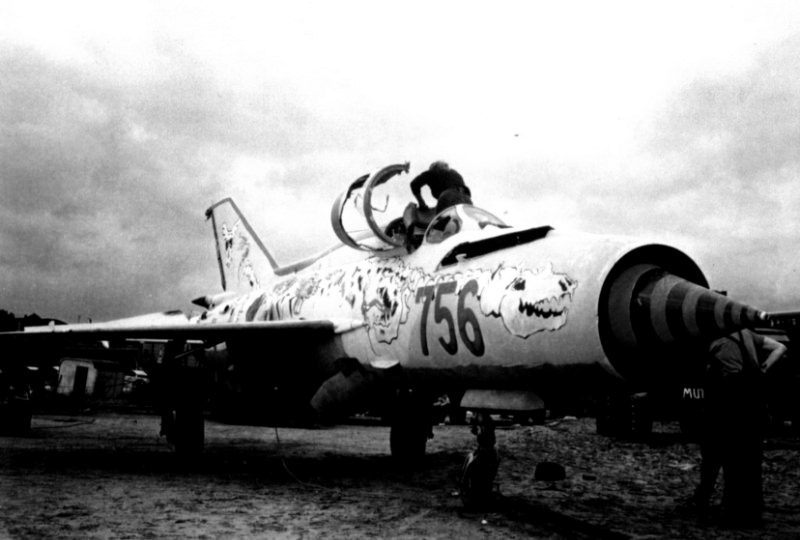
A low-slung, jet-like sculpture sits on rough ground beneath a heavy sky, its nose stretched into a striped cone and its skin scribbled with hand-painted graphics. The large number “756” dominates the fuselage, while cartoonish faces and jagged lines turn the bodywork into a moving billboard of punk-era imagination. Figures hover around and on top of the craft, giving a sense of scale and the slightly theatrical, built-for-performance energy associated with the Mutoid Waste Company’s 1980s scrap art.
What reads at first like a military aircraft quickly reveals itself as a bricolage of salvaged parts—metal panels, exposed framework, and improvised contours that feel more like a stage prop than a machine meant to fly. That tension between menace and play is the point: the work borrows the authority of industrial design, then undermines it with graffiti-like illustration and exaggerated shapes. In the context of car-scrap artworks, this kind of construction highlights how wreckage and discarded engineering can be reassembled into a new mythology.
Seen today, the piece speaks to an era when sculpture, subculture, and repurposed machinery collided in outdoor lots and alternative venues, far from the quiet of traditional galleries. The photograph’s grain and stark contrast emphasize texture—scuffed metal, painted surfaces, and the hard lines of fabrication—making it ideal for readers searching for “Mutoid Waste Company,” “scrap car art,” and “1980s industrial sculpture.” More than an oddity, it’s a vivid reminder of how artists turned waste into spectacle, building icons from what the road and scrapyard left behind.