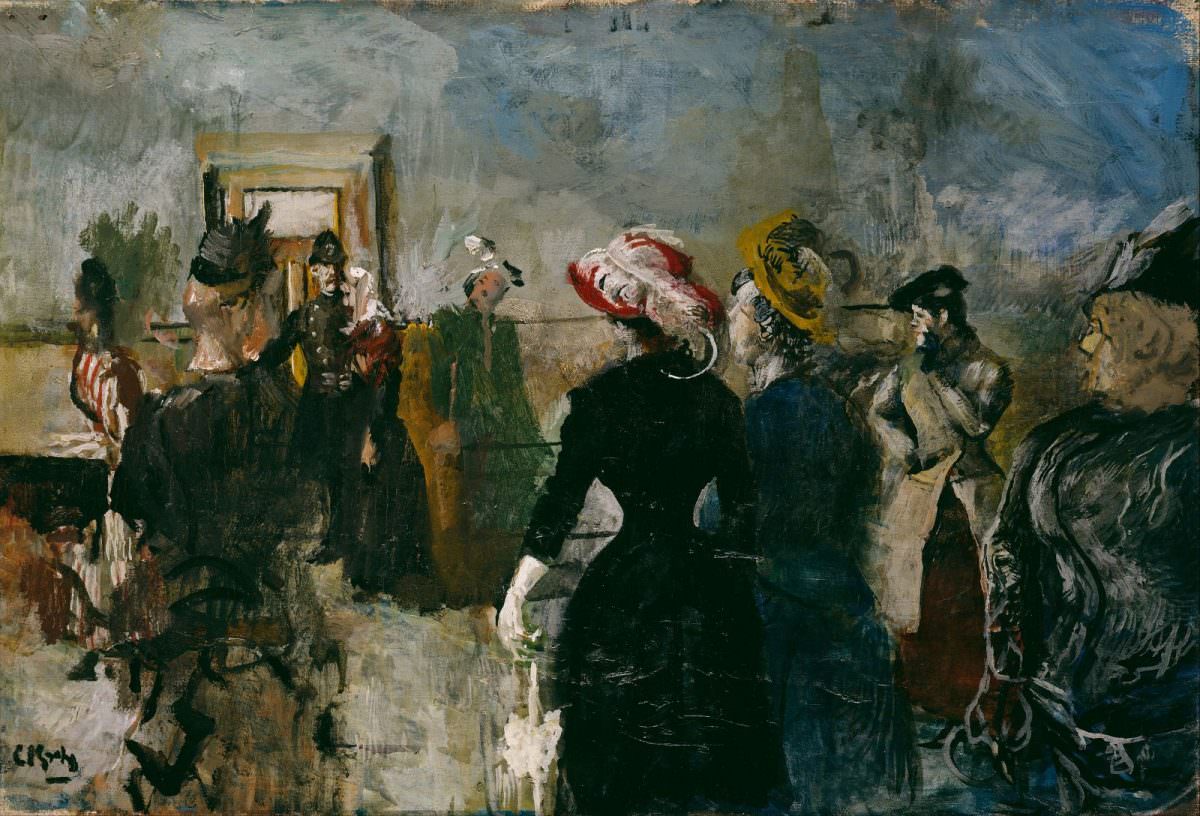
Muted grays and smoky blues set the stage for “Albertine, 1917,” a painterly scene of figures gathered in a dim interior, their faces suggested more than defined. Dark coats and brimmed hats form a loose crowd, while a vivid red hat near the center punctuates the composition like a spoken word in a hushed room. A doorway or framed opening in the background hints at movement beyond, yet the group seems held in place by the moment’s tension.
Brushwork carries much of the storytelling here: quick strokes, softened outlines, and layered paint create a sense of bustle without pinning the viewer to a single narrative. The contrast between deep blacks and pale highlights along sleeves and gloves draws the eye from one silhouette to the next, as if tracing a conversation. Rather than offering crisp detail, the artwork leans into atmosphere—an urban, early-20th-century mood where presence matters more than portrait-like precision.
Seen through the lens of 1917, the piece feels attuned to a world shaped by uncertainty, capturing social space as something crowded, transient, and psychologically charged. “Albertine” reads as both title and invitation, suggesting a personal story embedded within a broader public scene, even if the specific identity remains offstage. For readers searching for historical art, early modern painting, or 1910s visual culture, this image offers a striking study in how memory and observation can be rendered through color, gesture, and shadow.