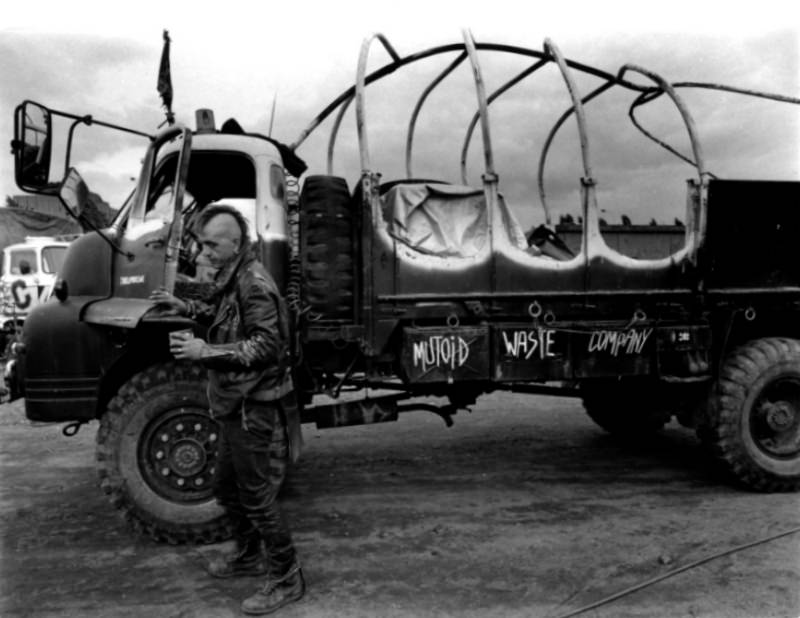
Parked on rough ground under a low, overcast sky, a heavy truck has been transformed into a rolling sculpture: its bed framed by looping metal ribs and lashings that suggest a cage, a ribcage, or the skeletal outline of some improvised creature. The hand-painted lettering along the side reads “MUTOID WASTE COMPANY,” turning the vehicle itself into a manifesto for scrap-built art and 1980s industrial rebellion. Even in grainy monochrome, the mix of machinery, salvaged parts, and theatrical silhouette telegraphs the strange magnetism of Mutoid aesthetics.
In the foreground, a worker in rugged clothes leans in close to the cab, cup in hand, as if taking a brief pause between bouts of welding, bolting, and hauling. The contrast between the everyday posture and the outlandish construction behind him is the point: these artworks were not polished gallery objects so much as lived-in, working creations assembled from scrapped cars, truck parts, and whatever metal could be rescued and reimagined. Tires, panels, and curved struts become both structure and story, hinting at the DIY ingenuity that defined this era of post-industrial art.
Beyond the truck, the open yard and distant buildings fade into the background, making the vehicle’s hybrid form feel all the more like a touring performance piece. For readers interested in Mutoid Waste Company history, 1980s scrap art, and the culture of repurposed automotive materials, the photograph offers a direct glimpse of how the movement looked on the ground—part workshop, part street spectacle. It’s a reminder that the bizarre brilliance of these car-scrap artworks came from turning discarded metal into something loud, mobile, and impossible to ignore.