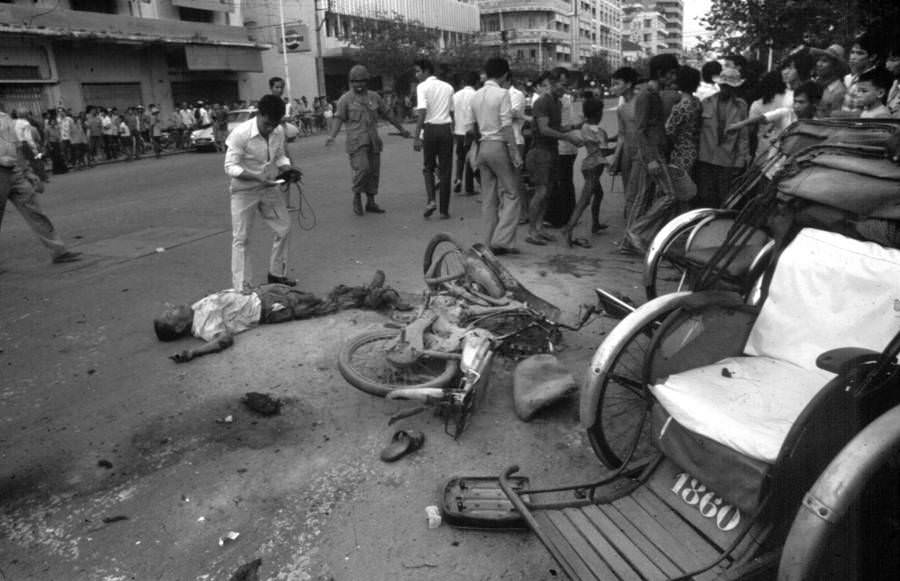
Street life in Phnom Penh is arrested in an instant as onlookers cluster around the body of a civilian lying in the roadway, a grim focal point amid everyday vehicles and storefronts. A bicycle and a cycle rickshaw sit at awkward angles nearby, their presence underscoring how ordinary motion and routine can collide with sudden violence. Faces turned inward, people seem caught between curiosity, shock, and the instinct to witness what has happened.
The title places this scene in 1975, during the Cambodian civil wars and the violent upheaval associated with the Khmer Rouge’s rise. Rather than a distant battlefield, the setting is an urban street where civilians and passersby become the immediate audience to terror, and where public space turns into a site of death and fear. The crowd’s tight ring hints at confusion and urgency—questions forming without answers, and a sense that danger may not be finished.
For readers searching for historical photos of Phnom Penh in 1975, Khmer Rouge violence, or images from Cambodia’s civil conflict, the photograph offers a stark, unfiltered record of a society on the edge. It invites careful viewing: the body, the scattered debris, and the halted traffic all speak to how quickly order can break down when armed power reshapes daily life. As a document, it is less about spectacle than about testimony—an uncomfortable but necessary glimpse into the human cost of political collapse.