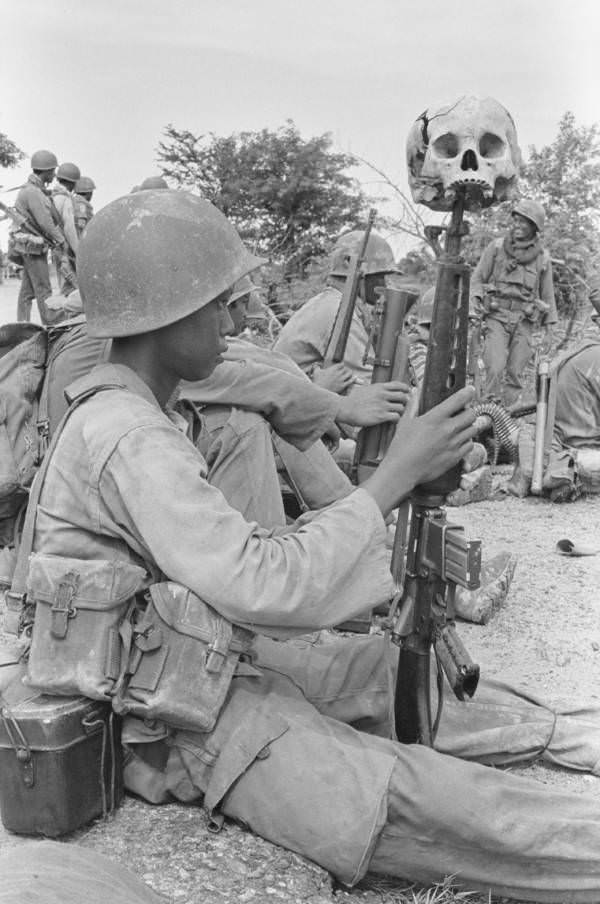
Against a rough roadside backdrop in Dei Kraham, Cambodia, a helmeted boy sits low among other soldiers, his posture focused on the rifle in his hands. Perched on the weapon’s tip is a human skull, stark against the pale sky, transforming a routine moment of handling gear into an unsettling tableau. The contrast between the child’s youthful profile and the instruments of war around him makes the scene difficult to look away from.
Details in the frame speak to a wider conflict rather than a single encounter: packs and pouches, scattered equipment, and several armed figures positioned close together as if pausing between movements. The skull, presented like an improvised marker or trophy, underscores how death can become normalized amid civil war conditions. In 1973 Cambodia, such images reflect a society strained by violence, displacement, and the steady erosion of ordinary childhood.
For readers seeking historical context, this photograph is a powerful entry point into discussions of child soldiers, battlefield symbolism, and the lived reality of Cambodia’s civil wars. It also raises quieter questions—about fear, coercion, and survival—that statistics alone cannot convey. As a piece of wartime photography, it remains a haunting document of how conflict remakes both landscapes and lives.