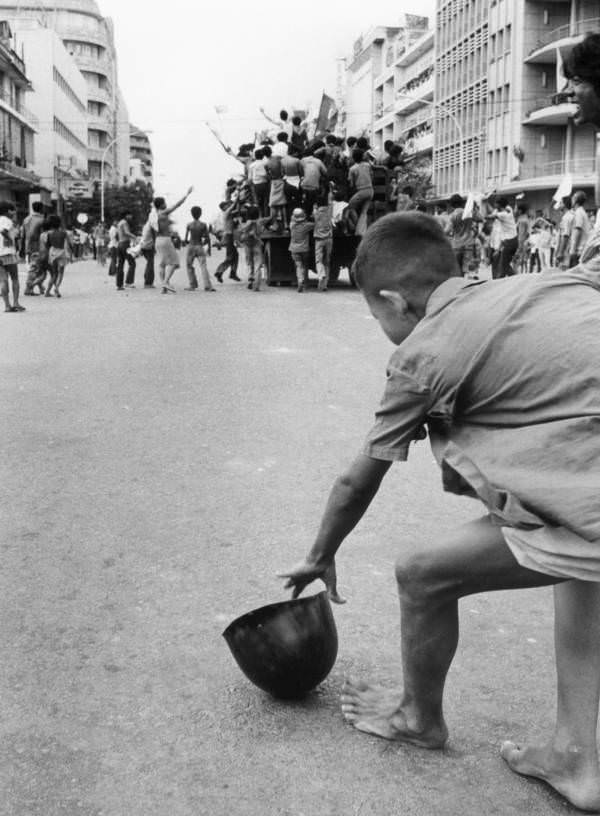
Near the bottom edge of the frame, a barefoot boy bends toward a discarded helmet, his small hand reaching for an object that suddenly carries the weight of a nation’s upheaval. The street around him opens into a broad corridor of concrete and modern facades, where scattered onlookers and moving figures hint at a city caught between ordinary routine and forced transformation. In the distance, a crowded vehicle packed with cheering men surges forward, turning the roadway into a stage for triumph and uncertainty.
Behind the child’s gesture, the victorious Khmer Rouge parade advances through Phnom Penh, the crush of bodies raised above the truck bed like a living banner. Arms lift, flags flutter, and people spill into the roadway, creating a sense of momentum that pulls the eye from the quiet foreground to the clamorous center. The contrast is stark: one boy concentrating on a single piece of military gear while a whole political movement floods the avenue with celebratory energy.
Held in that moment, the helmet becomes more than lost equipment; it reads as a symbol of a civil war’s aftermath and the rapid remaking of public life. Street photography like this can feel deceptively simple, yet it preserves the textures of 1975 Phnom Penh—its architecture, its crowds, and the uneasy mix of exhilaration and foreboding that accompanies regime change. For readers exploring Cambodia’s modern history, the image offers a vivid entry point into how revolutions are experienced not only by soldiers and leaders, but also by children at ground level.