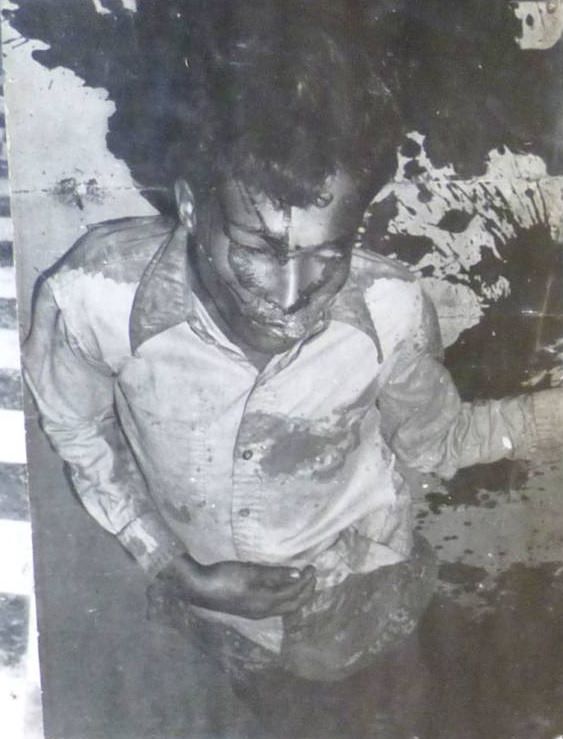
A man lies slumped against a wall, his shirt darkened with blood and his face turned downward as if the strength to look up has been taken away. The floor around him is slick and stained, and the harsh, close framing leaves little room to breathe—only the body, the concrete, and the evidence of violence. In Tuol Sleng, Phnom Penh, the camera’s distance is minimal, forcing the viewer into the same cramped space where suffering was recorded and preserved.
Tuol Sleng—known widely as S-21—has become one of the most searing symbols of Cambodia’s civil-war era, and images like this are part of why. The photograph reads like an official record made in the aftermath of brutality: stark, matter-of-fact, and unflinching. Even without visible captions or identifiers, the scene communicates the routine nature of terror inside the prison’s rooms, where injuries were not accidents but outcomes.
For a WordPress post exploring the history of Tuol Sleng in 1976, this picture offers a difficult but essential focal point for discussing memory, documentation, and the human cost of conflict. It speaks to how institutions of repression try to reduce people to evidence—while the humanity of the victim still breaks through in the posture of the body and the damage done. Readers searching for Khmer Rouge history, Tuol Sleng prison photographs, Phnom Penh 1976, or Cambodia civil war imagery will find in this single frame a sobering entry into a broader story that must not be forgotten.