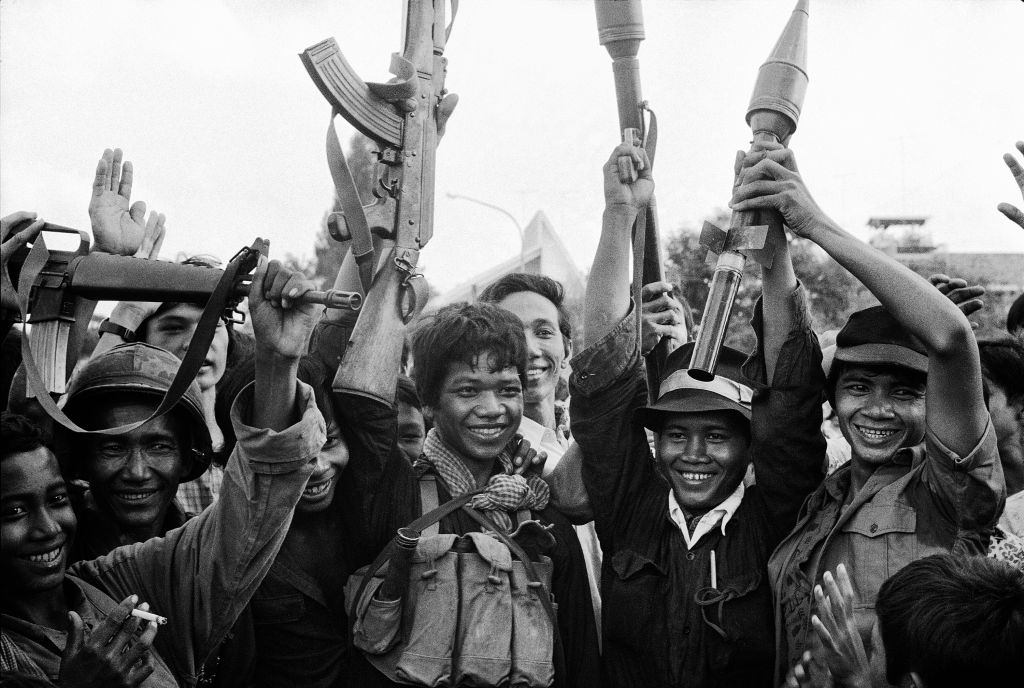
Raised rifles and rocket launchers slice into the sky as a tight crowd presses toward the camera, faces lit with grins and shouts. The mood in the frame is unmistakably triumphant—hands lifted, weapons aloft, bodies jostling in celebration—capturing the charged immediacy of a city changing hands. In the context of the title, the photograph reads as a visual threshold: the moment Phnom Penh fell on April 17, 1975, and the Cambodian Civil War pivoted into a new and darker chapter.
Expressions here are as telling as the hardware: young men beam, some in simple field clothing and caps, while others lean in from the edges, eager to be seen at the center of history. The close composition heightens the sense of momentum, as if the crowd’s energy could spill beyond the borders of the image. Details like cigarette smoke, worn fabric, and the tangle of arms give the scene a raw, street-level authenticity that aligns with eyewitness accounts of sudden victory and swift upheaval.
For readers searching the history of the Khmer Rouge takeover of Phnom Penh, this photo offers a stark reminder that revolutions can look jubilant at the instant of their success. What is absent—civilians being ordered out, deserted streets, the looming machinery of control—also matters, because it underscores how a single photograph can freeze one emotion while history unfolds beyond the lens. As a historical artifact, it invites reflection on how power is announced, how conflict ends in public, and how quickly celebration can give way to tragedy in Cambodia’s twentieth-century story.