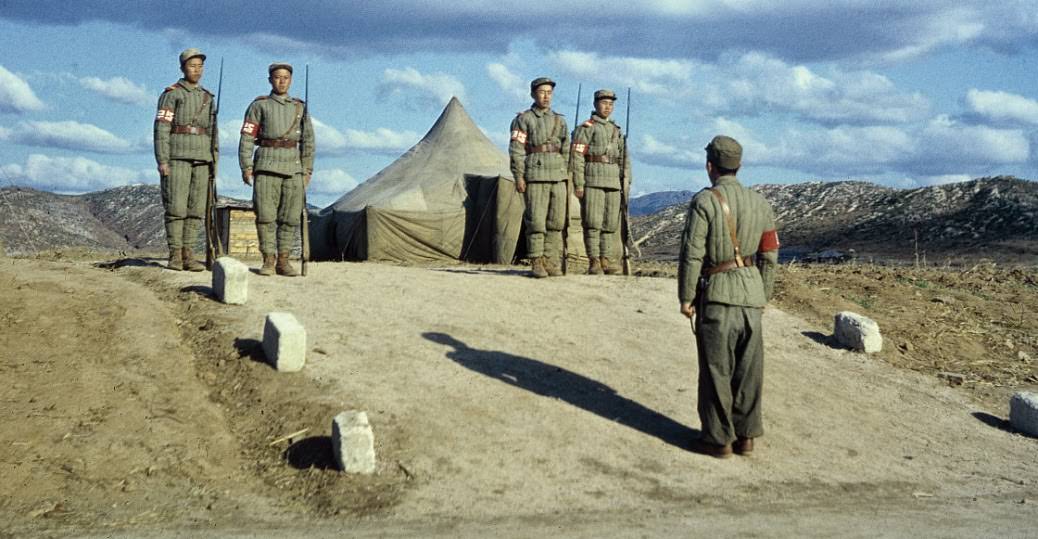
Under a wide, cold sky, uniformed soldiers stand at attention beside a canvas tent, their rifles held upright as if time itself has been ordered to pause. The bare earth and scattered marker stones hint at a boundary meant to be clear even when the landscape offers few natural lines. One figure faces the formation, suggesting inspection or ceremony—routine discipline on a frontier that had only recently stopped burning.
July 1953 ended active fighting on the Korean Peninsula after long negotiations, yet the settlement left a tense geography in place: a border running near the prewar 38th parallel and a demilitarized zone formally separating North and South. Photographs like this carry the ceasefire’s paradox—quiet scenes built on military readiness, where “peace” is measured in guarded posts and watchful formations. The war’s legacy reads not only in maps and communiqués, but in the posture of men stationed to ensure the line holds.
For readers tracing Korean War history, the DMZ’s creation marked a new chapter rather than a clean conclusion, because no formal truce ever resolved the conflict in the fuller sense. The camp setting, the distant hills, and the ritual of standing guard evoke the daily reality of an armistice: endurance, vigilance, and a border made permanent by uncertainty. Seen today, the image invites reflection on how ceasefire agreements can freeze a civil war’s divisions into the landscape for generations.