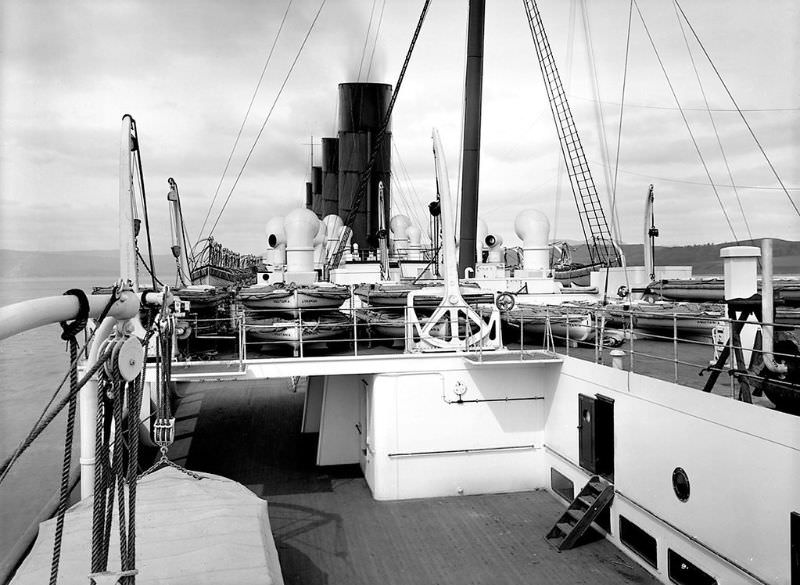
A broad stretch of passenger deck is interrupted by ranks of additional collapsible lifeboats, stacked and secured where open-air strolling space would normally invite fresh sea wind and conversation. Rigging lines, davits, and neatly ordered fittings frame the view forward, while the ship’s funnels rise beyond like an industrial skyline at sea. Even without a crowd in the frame, the altered layout hints at a vessel adapting—prioritizing emergency capacity over comfort in a very visible way.
Around 1914, passenger steamships were navigating a new era of safety expectations, and the deck became a kind of proving ground for practical innovation. Collapsible lifeboats, designed to be stored more compactly than traditional boats, offered a solution when a ship’s existing davits and clear deck areas were already spoken for. The result, as this photograph makes plain, was a compromise that second-class passengers would have felt immediately: fewer open spaces to enjoy the voyage, more equipment occupying the prime real estate along the rail.
For readers interested in maritime history, ocean liner safety, and early 20th-century ship design, this scene is a revealing snapshot of how regulation and public pressure reshaped everyday travel. Details like the tightly packed boats, the orderly deck hardware, and the purposeful arrangement of gear speak to a transitional moment when “inventions” were not just clever mechanisms, but answers to hard lessons learned at sea. It’s an image that invites a closer look at the balance between engineering, passenger experience, and the evolving language of safety aboard passenger ships.