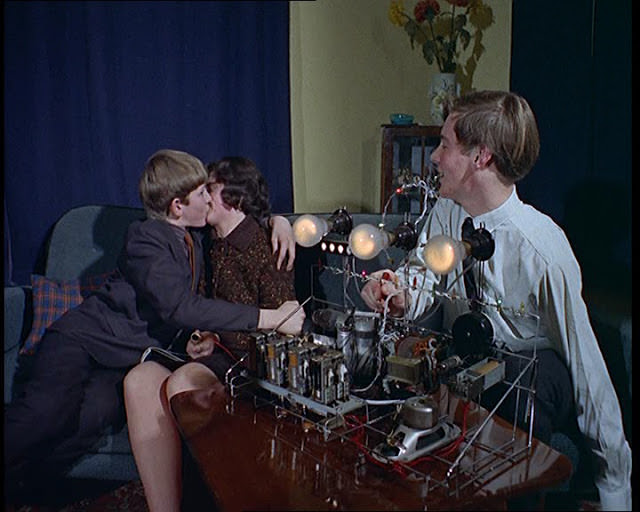
Few inventions sound as cheeky as the “Snogometer,” and the photo leans into that playful mid‑1960s optimism about measuring just about everything. In a cozy living-room setting, a young couple kiss on a sofa while a tangle of wires and components sprawls across a low table in front of them, the contraption’s bulbs glowing like a homemade control panel. A man in a white shirt sits nearby, watching the proceedings with the calm focus of an experimenter, as if romance itself has become a testable hypothesis.
The scene reads like a snapshot of pop science meeting pop culture: part laboratory, part lounge. Vacuum-tube-style parts, exposed circuitry, and a cage-like frame give the device a mad-inventor look, while the couple’s body language keeps the tone light and mischievous. Those lit indicators suggest the “reading” is meant to be visible, turning private affection into a public metric—an amusing twist that fits the era’s fascination with gadgets, television demonstrations, and novelty inventions.
For anyone browsing inventions of the 1960s, this image offers a memorable example of how technology was often framed as entertainment as much as progress. It also hints at changing social attitudes, where youthful courtship could be teased, observed, and even “quantified” for a laugh. Whether the Snogometer was ever more than a stunt, the photo endures as a witty artifact of 1965: a time when even a kiss could be wired up, lit up, and put on display.