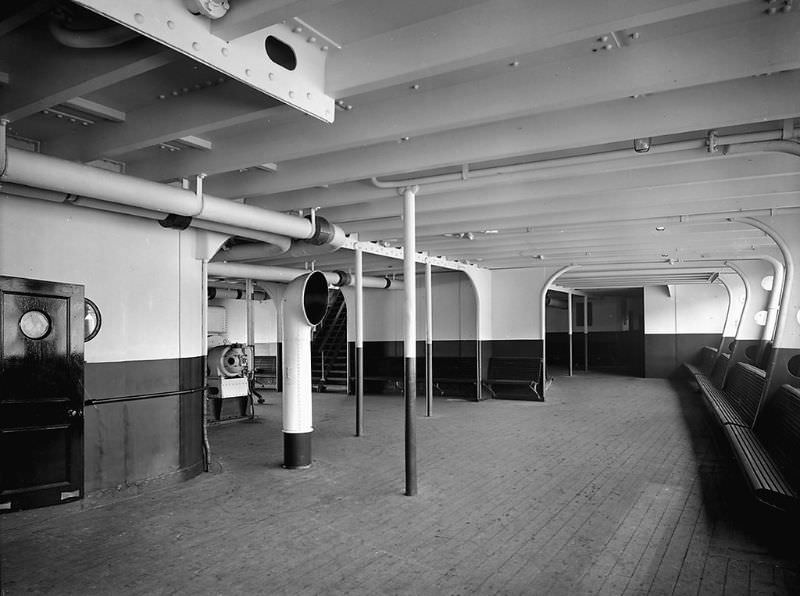
Under the low ceiling of Aquitania’s Upper Deck (D Deck), the third-class promenade stretches aft along the port side in a long, sheltered corridor of steel and timber. Riveted beams, thick piping, and evenly spaced stanchions create a purposeful rhythm overhead, while the planked deck underfoot suggests the constant wear of sea air and passenger traffic. At the right edge, sparred seats run tight to the bulwark, positioned for those small stolen moments of rest while still close to the ship’s side.
Looking aft, the space feels both open and contained—an in-between world where movement and waiting would have mixed throughout a voyage. The gentle curve of the ship’s structure, the shadowed corners, and the utilitarian fittings hint at the practical design priorities of an early 20th-century ocean liner: shelter from wind and spray, clear passage along the deck, and simple comforts that didn’t waste an inch. Even without people present, the promenade reads like a stage set for daily routines—strolling, conversation, and watching the wake trail behind.
As a historical deck view from May 1914, this photograph offers a valuable glimpse into how third-class accommodations were arranged on a famous liner at the height of the transatlantic era. Details like the sparred bench seating, the protective bulwark, and the shipboard hardware make it a strong reference image for anyone researching passenger life, maritime architecture, or Cunard’s design choices before the First World War. For readers interested in the material culture of ocean travel, Aquitania’s third-class promenade stands as a quiet reminder that even “everyday” spaces aboard ship were carefully engineered to manage comfort, crowds, and the sea itself.