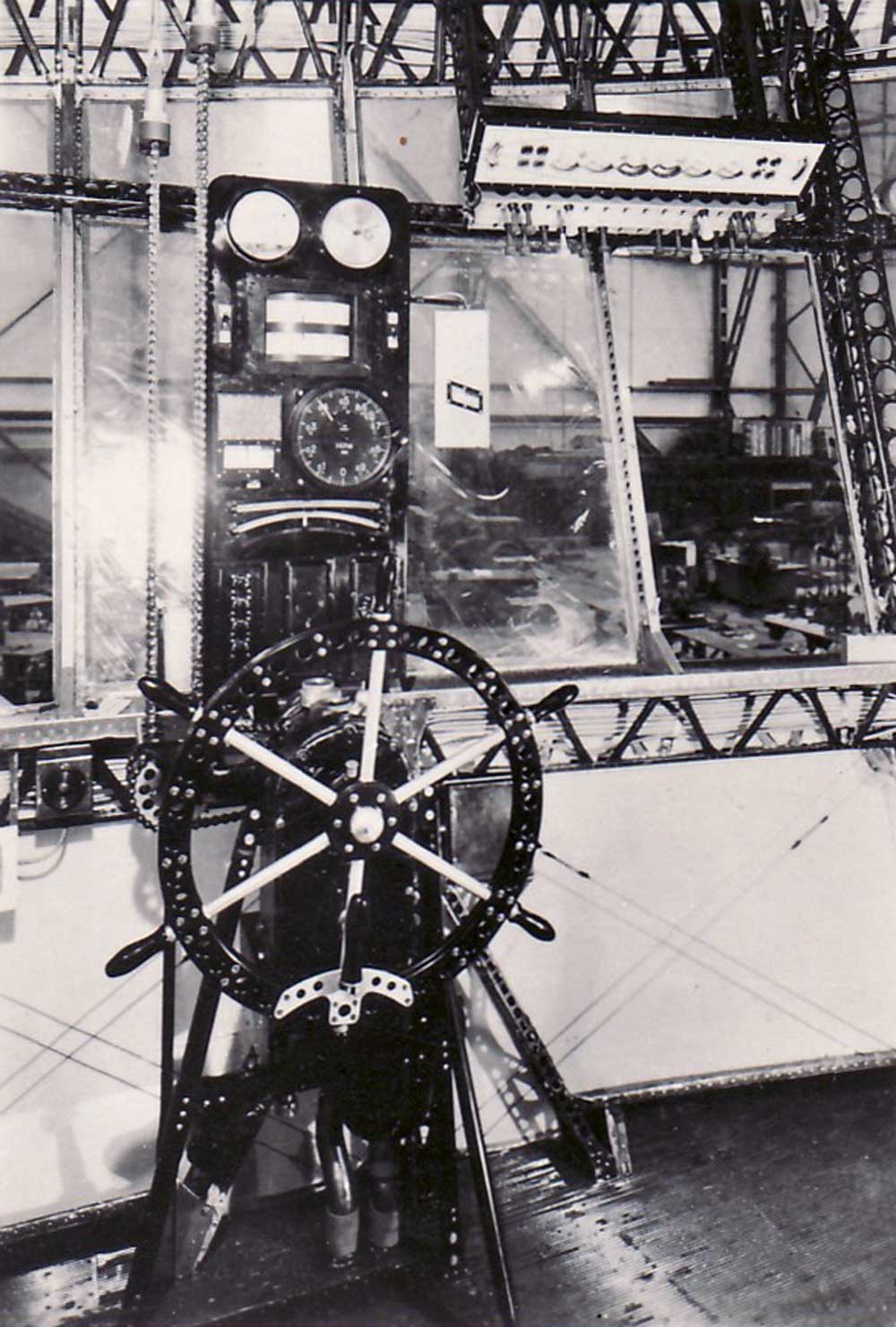
Dominating the foreground is a spoked elevator wheel, its perforated rim and sturdy hub suggesting the deliberate, hands-on control demanded by early airship flight. Behind it, a compact instrument panel stacks round gauges and switches into a vertical column, turning the airship’s skeletal framework into a working cockpit-like station. The surrounding lattice of metal members and cables hints at the vast internal architecture of the Hindenburg, where lightweight structure and careful routing mattered as much as raw power.
What makes this view so compelling is how it pulls attention away from the airship’s famous exterior and into the practical mechanics that kept it steerable and stable. The elevator wheel relates directly to pitch control, while the panel would have provided operators with at-a-glance readings essential for safe handling. In this same operational neighborhood, a ballast board speaks to the constant balancing act of buoyancy—fine adjustments that helped maintain trim as conditions and loads changed.
For readers interested in inventions and aviation history, the photograph offers a close-up look at the engineering culture of the era: functional, robust, and built for real-time decision-making. Details like chain runs, mounting brackets, and the disciplined arrangement of controls point to a system designed to be managed by trained hands rather than automated logic. As a searchable glimpse into Hindenburg interior equipment—elevator control wheel, instrument panel, and ballast management—this image anchors the story of how giant dirigibles were actually flown.