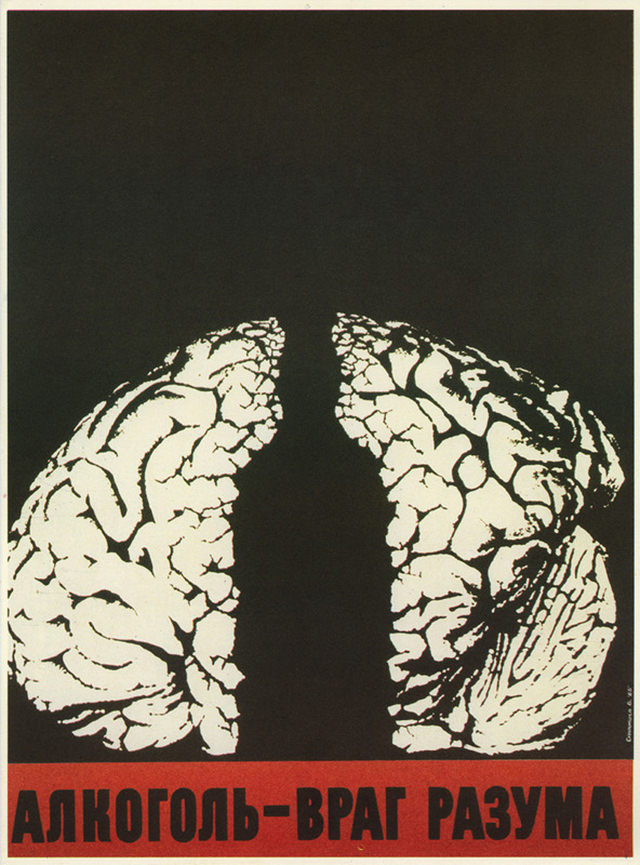
A stark poster confronts the viewer with a split brain rendered in bold black and white, its two halves separated by a dark void that feels like a widening rift in judgment. Beneath the image, the Russian slogan “АЛКОГОЛЬ — ВРАГ РАЗУМА” translates directly to “Alcohol is the enemy of reason,” leaving no ambiguity about the message. The minimal palette and heavy contrast give the artwork the severity of a warning sign rather than a gentle appeal.
In this composition, the brain becomes both subject and symbol: a familiar organ turned into an emblem of threatened clarity. The fracture down the center suggests erosion—of self-control, memory, and rational thought—without needing to depict a bottle or a drinker. It’s visual propaganda at its most economical, relying on anatomy and typography to make alcohol’s consequences feel immediate and universal.
Placed in the context of historical anti-alcohol and temperance campaigns, the piece reads like a public-health sermon delivered through modern graphic design. For readers searching for Soviet-era poster art, anti-alcohol propaganda, or the visual history of social reform, this image offers a concise study in how fear and reason were mobilized on the printed page. Its enduring power lies in the simplicity: one organ, one accusation, and a silence around it that invites reflection.