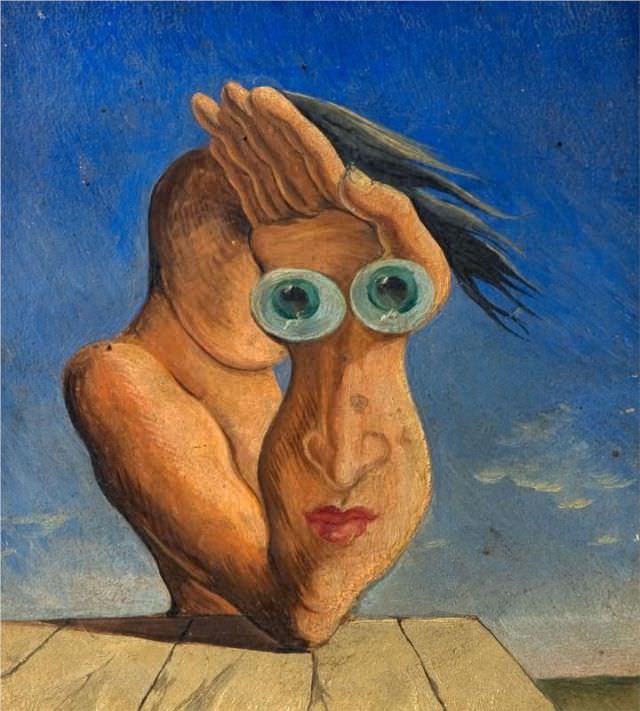
A face seems to materialize out of unlikely parts: a broad, sculpted hand pressed to the forehead, a swoop of dark hair, and two oversized, glassy eyes that hover like lenses. Set against an open blue sky, the figure reads as both portrait and object—an early 1930s “composition without portrait” that plays with the very idea of what a likeness is supposed to be. Warm, fleshy tones and careful shading give the form a tactile presence, even as its anatomy refuses realism.
What makes the scene linger is the tension between clarity and distortion. The eyes, rendered as pale circular discs, pull attention forward, while the elongated nose and small red mouth anchor the image in familiar facial cues. Below, a plank-like surface introduces perspective lines and a stage-like setting, as if the assembled head has been placed on a tabletop for inspection, study, or quiet confrontation.
In the broader story of early 1930s modern art, this kind of playful disassembly speaks to a period fascinated by perception, psychology, and the constructed nature of identity. The work’s surreal humor—part mask, part collage, part dream—turns a simple viewing into a puzzle, inviting visitors to linger and interpret. For WordPress readers searching for early 1930s artwork, surrealist-inspired painting, or modernist portrait experimentation, this image offers a striking example of how artists reshaped the human figure without relying on a traditional portrait.