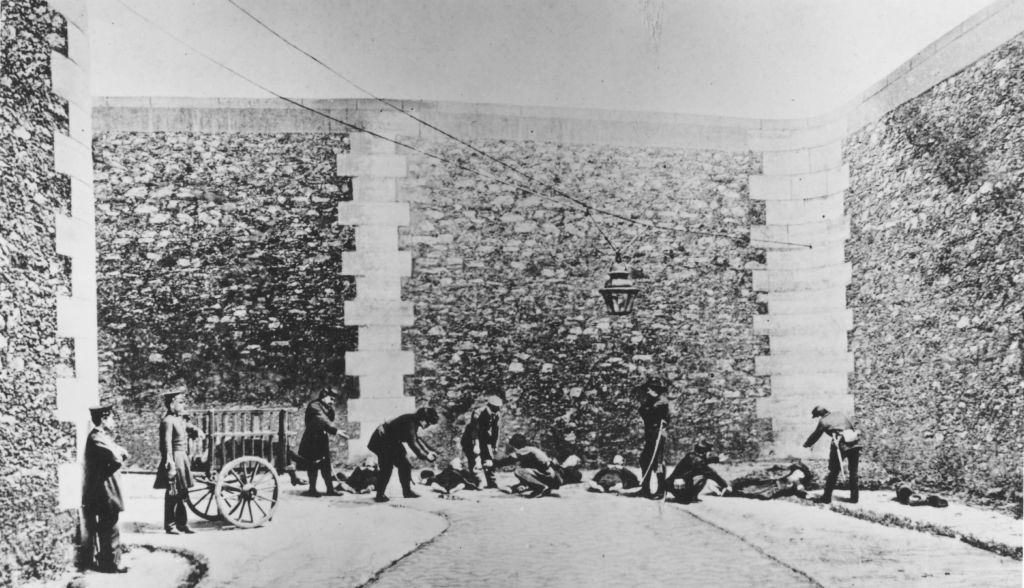
Under a high stone archway, soldiers and laborers move with grim purpose along a bare roadway, bending to lift the dead and gather them into a rough line. A small cart with wooden wheels waits nearby, while scattered hats and dark bundles on the ground suggest how sudden and chaotic the violence was. The harsh walls and hanging lantern box the scene in, turning the passage into a corridor of aftermath rather than a thoroughfare.
At the end of the Franco-Prussian War, the Paris Commune left the city fractured by civil war, and photographs like this one document what official reports often softened or ignored. The men at work are not posed for glory; they are engaged in the unheroic labor that follows street fighting—removal, sorting, and transport—tasks that made it possible for authorities to reassert order and for daily life to resume. Even without visible landmarks or legible signs, the image carries the unmistakable atmosphere of Paris in crisis, where public space became a battlefield and then a morgue.
For readers searching the history of the Paris Commune, this stark record offers a window into the human cost that lay behind debates about revolution, repression, and the future of France. The composition emphasizes distance and scale: small figures dwarfed by masonry, bodies reduced to shapes, and a cart that hints at the routine logistics of mass death. It’s an unsettling but essential historical photo—one that anchors “Civil Wars” not in abstraction, but in the physical work of collecting what violence leaves behind.