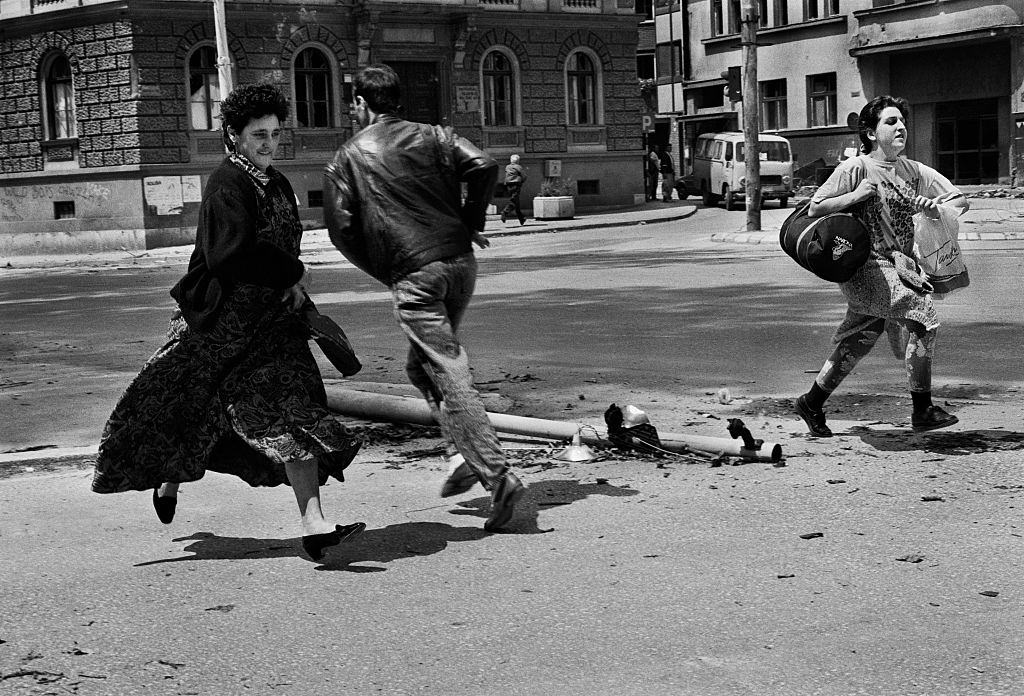
In a broad Sarajevo street, three civilians break into a sprint, skirts and jackets whipping in the wind as they race past scattered debris and a fallen pole. Their arms are full—bags clutched tight, a shoulder strap pulled close—small, ordinary burdens made urgent by the need to cross open ground fast. Behind them, heavy stone façades and parked vehicles form a rigid urban backdrop, indifferent architecture framing a moment of raw fear.
“Sniper Alley” became a grim nickname during the 1992 siege of Sarajevo, a reminder that a simple commute could turn into a life-or-death dash. The title’s mention of gunmen and sights casts a shadow over every detail: the exposed roadway, the lack of cover, the way each person commits to motion rather than hesitation. This is civil war at street level, where front lines aren’t distant trenches but intersections and sidewalks.
For readers searching the history of the Bosnian War and the siege of Sarajevo, the photograph distills the conflict’s defining cruelty—violence aimed not only at soldiers, but at daily life itself. It’s also a testament to resilience: people still moved through the city, still carried what they could, still chose speed and solidarity over paralysis. The image lingers because it offers no safe distance; it places us in the middle of an ordinary street made lethal, and asks us to remember what that meant for those who lived it.