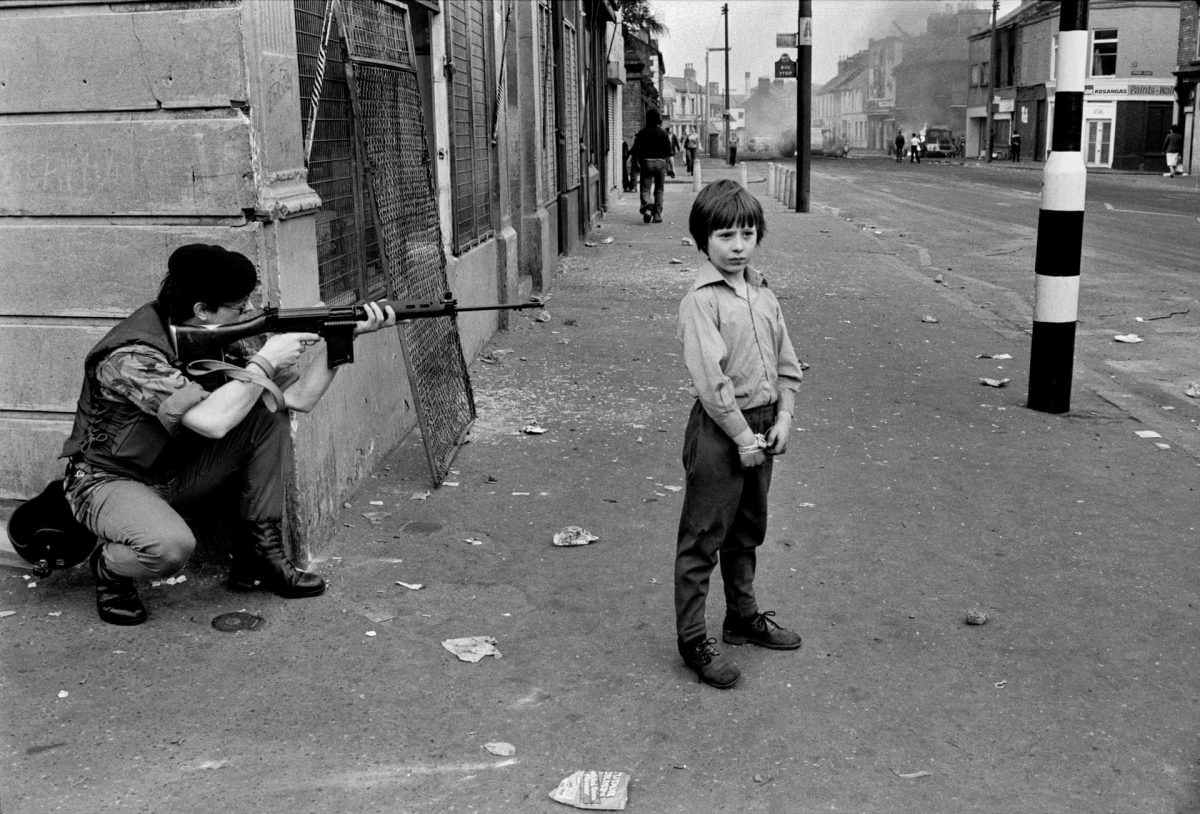
At the bottom of Clonard Street in Belfast, 1978, a soldier crouches tight to a battered wall, rifle levelled down an ordinary city road turned suddenly precarious. The hard lines of the shopfronts and shuttered windows funnel the eye into the distance, where haze and scattered figures suggest movement, tension, and uncertainty. Litter on the pavement and the stark street markings add to the feeling of a neighbourhood living under strain rather than routine.
Near the centre of the frame, a child stands on the pavement with hands together, looking toward the camera while danger seems to sit just off to the left. That quiet, human detail cuts against the soldier’s posture and the rigid aim of the weapon, capturing a grim closeness between civilian life and armed presence. It’s an uneasy juxtaposition that speaks volumes without needing explanation: everyday streets, everyday people, and the intrusion of conflict.
For readers searching for Belfast 1978 history, Northern Ireland conflict photography, or images from the Troubles, this scene offers a stark record of how urban space can be reshaped by fear and security. Clonard Street is presented not as a landmark but as a lived environment—stone, tarmac, and storefronts bearing the weight of political violence. The photograph invites reflection on what “civil wars” look like at ground level: not battlefields, but pavements where childhood and military vigilance briefly share the same narrow strip of street.