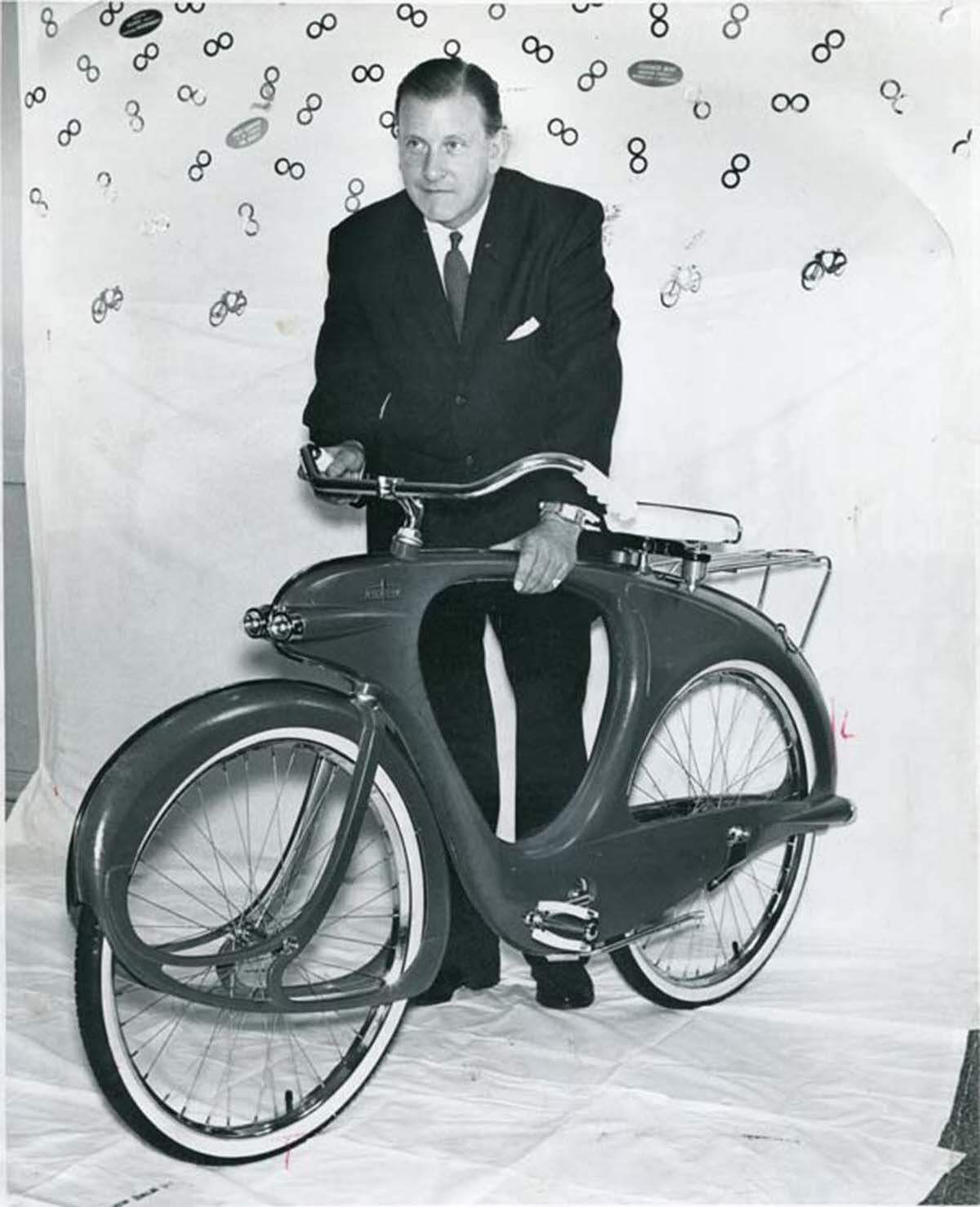
A suited man poses with an unusually streamlined pedal bicycle, its bodywork flowing in one continuous curve from headlamp to rear rack. Instead of the familiar lattice of steel tubes, the frame appears enclosed, creating a smooth shell that hints at mid-century industrial design and the era’s fascination with modern materials. Details like the deep fenders, wide saddle, and integrated front light make it feel closer to a concept vehicle than an everyday commuter bike.
Behind the rider, the backdrop is patterned with small bicycle icons, a playful reminder that even the simplest inventions invite endless rethinking. The photograph reads like a presentation moment—part demonstration, part advertisement—where function and style are being sold together. It’s a striking contrast to the post title’s plain description of “two wheels… joined by steel tubes,” because here the engineering seems intentionally hidden, as if speed and cleanliness were as important as mechanics.
In the broader story of inventions, bicycles occupy a special place: familiar enough to be taken for granted, yet constantly redesigned in response to fashion, technology, and changing streets. This historical photo highlights that tension between the ordinary pedal bicycle and the dream of a sleeker, more futuristic ride. For readers interested in cycling history, industrial design, or the evolution of everyday transport, it offers a memorable glimpse of how innovators tried to reshape a classic form without changing its essential purpose.