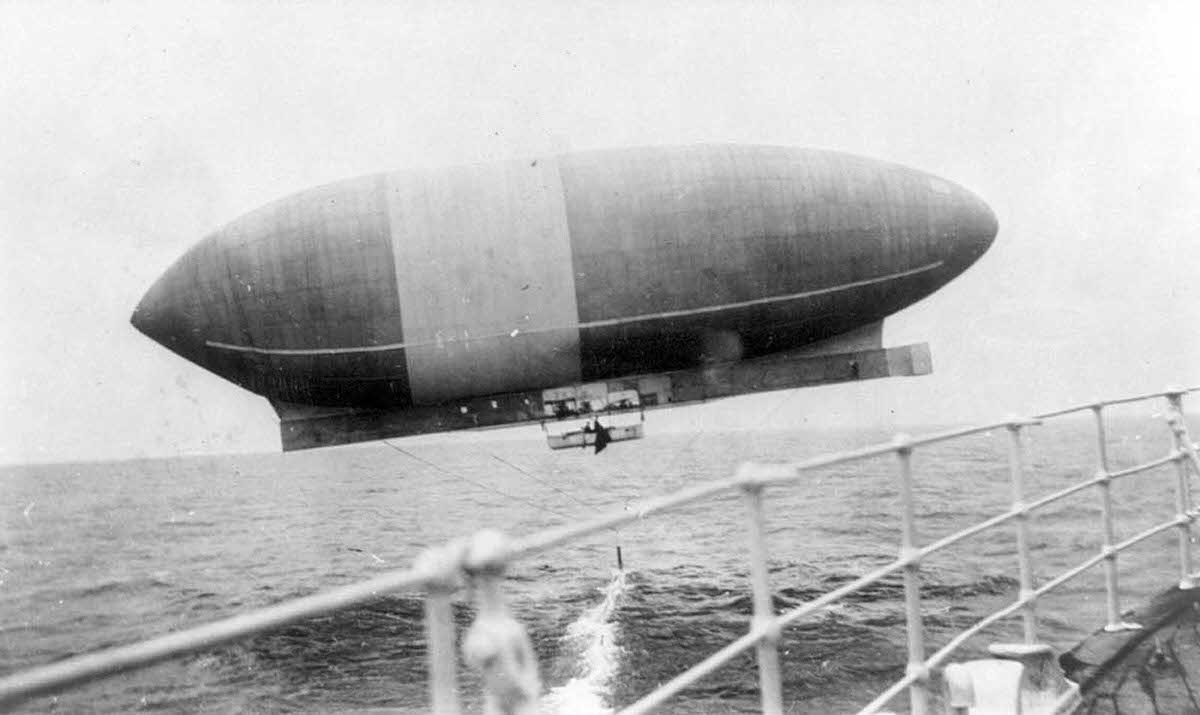
From the deck of the RMS Trent, the Wellman airship “America” hangs low over open water, its broad envelope filling the sky while the ship’s railings frame the scene in the foreground. The camera angle places the viewer among the onlookers at sea level, looking up at an early airship that seems both immense and oddly fragile against the pale horizon. Even at a glance, the stark contrast between steel ship and lighter-than-air craft makes the moment feel like a meeting point between two eras of travel.
A thin line trails beneath the gondola, and the title’s detail—“dragging her anchor”—adds a jolt of tension to the quiet surface of the ocean. The wake and disturbance in the water below suggest motion and improvisation, a reminder that early aviation often relied on practical, sometimes risky solutions when weather, steering, or equipment refused to cooperate. Inventions were not merely dreamed up in workshops; they were tested in unforgiving conditions where a single tether could decide what happened next.
As a piece of aviation history, this circa-1910 view offers an unusually immediate look at airship experimentation witnessed from a passenger vessel rather than a land-based crowd. It invites readers interested in the Wellman airship America, the RMS Trent, and the broader story of pioneering flight to linger over small details—rigging, scale, and the uneasy proximity to the sea. The photograph doesn’t just document a machine; it preserves the atmosphere of early twentieth-century innovation, when the future of transportation still looked uncertain, and spectacular.