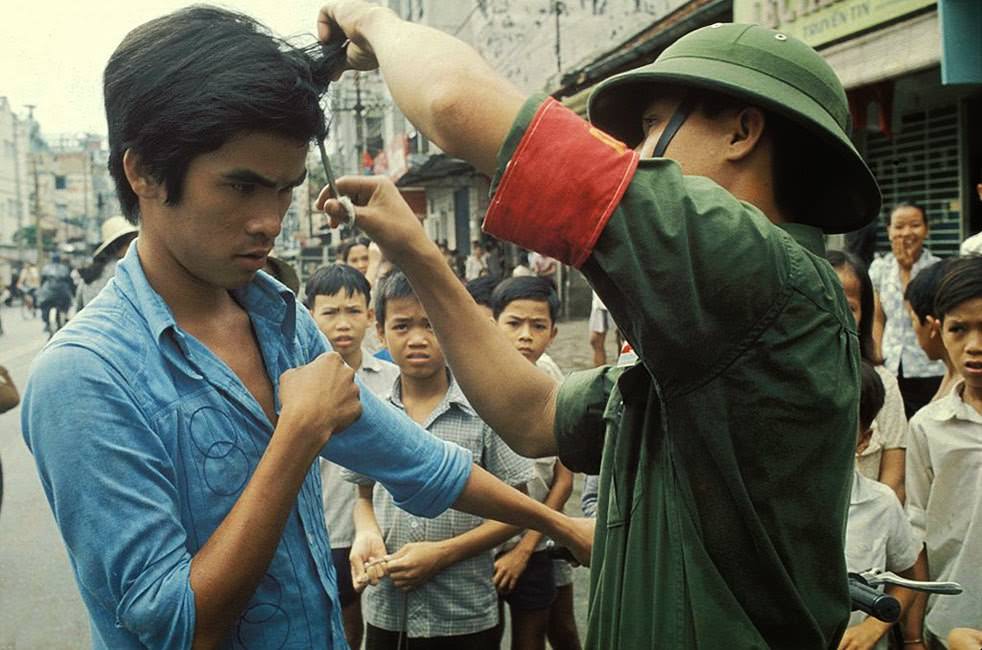
On a busy Vietnamese street during the Vietnam War era, a uniformed man raises a fistful of hair and brings scissors close, turning an everyday grooming ritual into a public demonstration of control. The young man being held stands tense and unsmiling, his “western” shirt pulled taut at the shoulder, while a small crowd—mostly boys and teenagers—watches from only a few steps away. Faces in the background register curiosity, unease, and attention, underscoring how quickly private life could be drawn into the conflict’s visible theater.
The title’s reference to the Vietcong cutting hair and “western” clothes points to a broader struggle over appearance, identity, and allegiance. In many revolutionary movements, hair length and imported fashions become symbols to be regulated, not merely personal choices, and the act of trimming or stripping such markers functions as humiliation as well as warning. Here, the scissors and the grip replace courtroom or decree, suggesting that power could be asserted instantly, in daylight, and before witnesses.
Details of the scene—streetfront buildings, the tight ring of onlookers, the practical military gear—anchor the image in the urban uncertainty that defined much of the war’s social landscape. For readers exploring Vietnam War history photographs, this moment illustrates how political pressure could reach into hairstyles and wardrobes, turning “western” style into a contested sign. The photograph invites reflection on what it meant to be watched, judged, and reshaped in public, where conformity could be enforced with a simple cut.