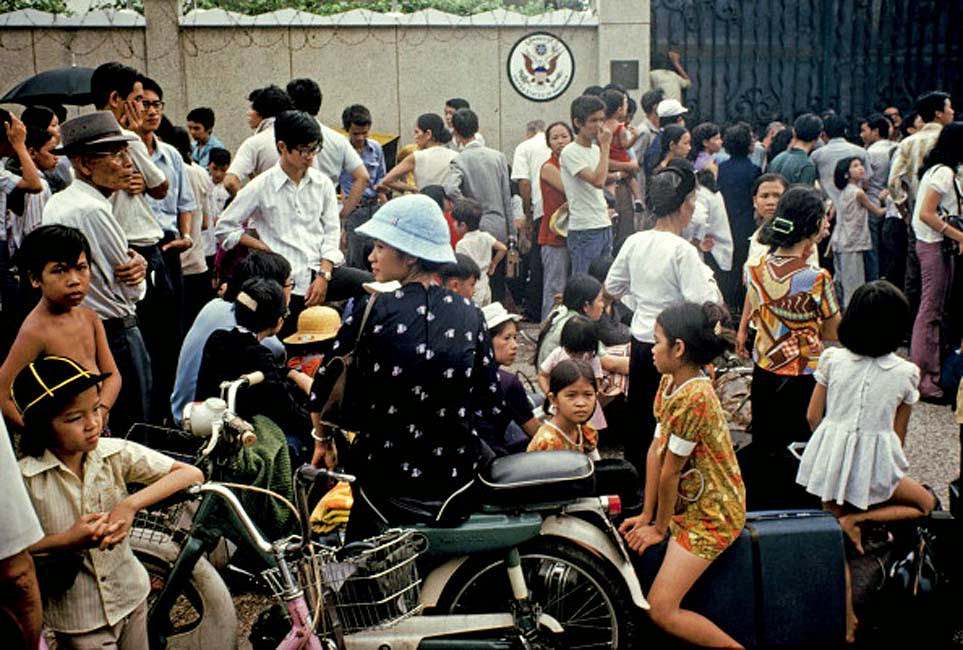
Crowds gather tightly along a high wall topped with barbed wire, drawn toward a guarded gate where the U.S. seal marks the American Embassy compound. Men in white shirts, women in patterned dresses, and children pressed close to adults create a layered scene of waiting and uncertainty, as if everyone is listening for news just out of frame. The street is cluttered with everyday life—motorbikes, baskets, and shaded umbrellas—ordinary objects made tense by the sheer density of people and the urgency in their body language.
Near the foreground, faces turn in different directions: some watch the entrance, others scan the street, and a few seem momentarily distracted, as though trying to keep calm for the children nearby. The embassy wall forms a stark boundary, both physical and symbolic, separating those outside from whatever safety or paperwork might be inside. Even without visible soldiers at every point, the set of the gate and the defensive line above it communicate how restricted access had become in the final hours of the Vietnam War’s closing chapter in the city.
Late April 1975 has come to represent a decisive turning point, and scenes like this help explain why—history isn’t only helicopters and headlines, but the long minutes spent standing shoulder to shoulder, hoping a door will open. For readers searching for the fall of Saigon, the American Embassy, or civilian experiences during the end of the Vietnam War, this photograph offers a grounded, street-level view of what crisis looked like for families and bystanders. The color, the crowding, and the embassy emblem combine to make a vivid record of anxiety, endurance, and the fragile routines that persisted right up to the edge of collapse.