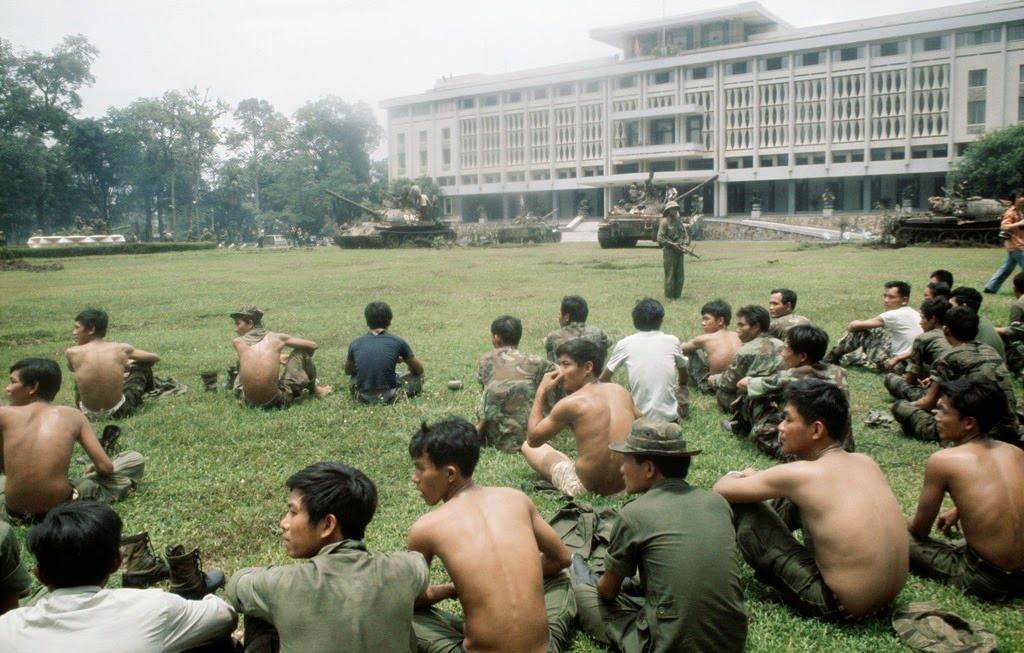
Across a wide lawn in front of Saigon’s presidential palace, captured South Vietnamese soldiers sit in loose rows, some shirtless, their uniforms and gear scattered at their sides. The men’s postures—leaning on elbows, turning to look back, faces set in fatigue and uncertainty—convey the stunned quiet that follows a sudden collapse of authority. Behind them, the palace façade looms with its repeating windows, an official backdrop now framing a scene of defeat and detention.
Armored vehicles rest on the grass and near the building, while an armed guard stands watch at mid-ground, creating a stark contrast between immobility and control. The open space feels exposed, as if the lawn itself has become a temporary holding area where the rhythms of military order have been replaced by waiting. Details in clothing and body language underline how quickly combatants can be reduced to prisoners in the shifting tides of war.
For readers tracing the final moments of the Vietnam War, this photograph distills the fall of Saigon into a single, unsettling tableau: the seized presidential palace, the presence of North Vietnamese troops, and the captured men left to sit with the consequences. It’s an SEO-relevant visual record of the end of South Vietnam and the reshaping of a city’s political center, captured not through speeches or flags, but through ordinary soldiers on a broad stretch of grass. The image invites reflection on surrender, survival, and the human cost that remains when the fighting stops.