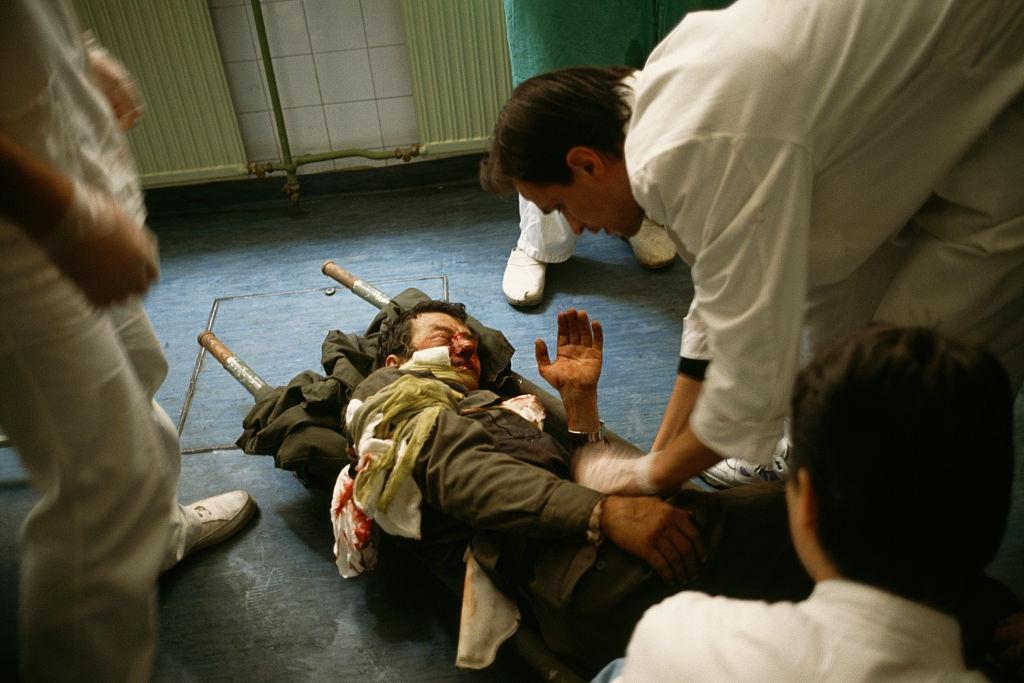
Inside a stark hospital room, a wounded man lies on the floor as medical staff in white coats crouch beside him, hands moving quickly between his arm and chest. Blood-stained cloth and a makeshift stretcher frame the scene, suggesting the urgency of triage when beds, time, and supplies were all in short supply. The title, “The situation in Sarajevo, 1994,” places this moment within the city’s wartime emergency, where civilian suffering and frontline medicine collided every day.
What stands out is the mixture of exhaustion and determination: one clinician leans in close, another hovers at the edge, and the injured man’s raised hand reads like a reflex—half signal, half plea. Fluorescent light and bare flooring emphasize how improvised care could become, turning corridors and corners into treatment spaces. Rather than grand battlefield imagery, the photograph focuses on the intimate, brutal reality of civil war—injury, shock, and the fragile line between survival and loss.
For readers searching for Sarajevo 1994 photos, Bosnian War history, or documentation of wartime hospitals and civilian casualties, this image offers a direct, human record. It reminds us that the story of conflict is also a story of caregivers improvising under pressure, and of ordinary people caught in extraordinary violence. Seen today, the photograph is both evidence and memorial: a single frame that speaks to the wider catastrophe implied by the brief phrase “Civil Wars.”