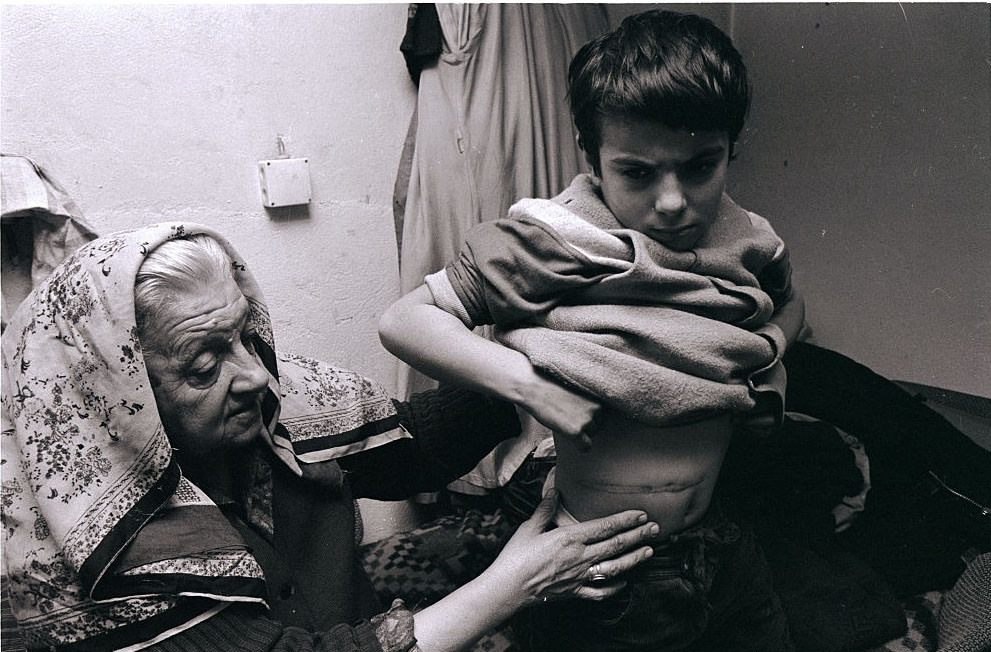
In a tight interior that feels both makeshift and intimate, Mirza Mangajic lifts his shirt while his grandmother steadies him with a protective hand. The boy’s expression is guarded and far older than ten, as if he has learned to measure pain in silence. Her lined face, framed by a patterned headscarf, turns toward him with the practiced attention of someone who has been forced to become nurse, guardian, and witness all at once.
A long scar stretches across Mirza’s belly, the lingering mark of a grenade explosion, and the camera does not look away. The room’s bare wall, a hanging garment, and the cramped bedding underscore how war compresses ordinary life into a few square feet. The tenderness of the grandmother’s touch contrasts sharply with the violence that caused the wound, capturing the uneasy coexistence of care and catastrophe that defines civilian survival in civil wars.
Sarajevo’s Old Town quarter is invoked in the title as more than a location; it becomes a symbol of a city where childhood and tradition endured under extraordinary strain. For readers searching for accounts of Sarajevo, the Bosnian war, and the human cost of urban conflict, this photograph offers a stark, personal entry point. It reminds us that history is carried on bodies and in family bonds, and that survival often depends on the quiet, relentless work of those who refuse to let the vulnerable face devastation alone.