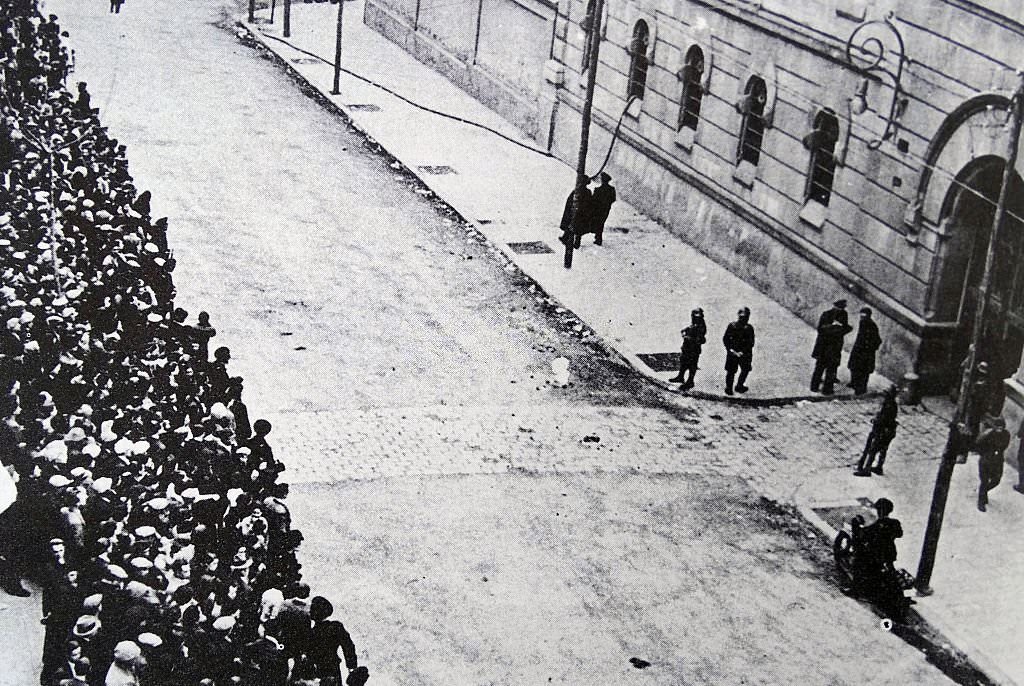
Along the prison wall in Barcelona, a dense crowd presses into the curve of the street, bodies packed shoulder to shoulder as if the city itself has come to wait. From an elevated viewpoint, the line of people forms a dark, rippling mass against the pale roadway, while the stone façade with its arched openings looms to the right. Small clusters of uniformed figures stand apart near the entrance, creating a tense geometry of separation: the many who hope, and the few who control the threshold.
February 1936 carried the promise of change in Spain, and the title points to a moment when left-wing political prisoners—including Catalan nationalists—were expected to be released. The photograph’s stark contrasts evoke more than a simple gathering; it suggests anticipation sharpened by uncertainty, the kind that hangs in the air when politics becomes personal and families, comrades, and sympathizers converge for news. In that narrow space between crowd and gate, you can sense how quickly celebration, anger, and fear might have traded places.
Seen today, this scene belongs to the prelude of the Spanish Civil War era, when amnesties, street mobilization, and competing visions for the republic collided in public view. The image works as a powerful historical document for readers searching for Barcelona history, Spanish politics in 1936, or the lived experience of civil conflict before the front lines hardened. It reminds us that major political shifts are often witnessed first not in parliament, but on pavements outside prisons, where ordinary people gather to mark a turning point.