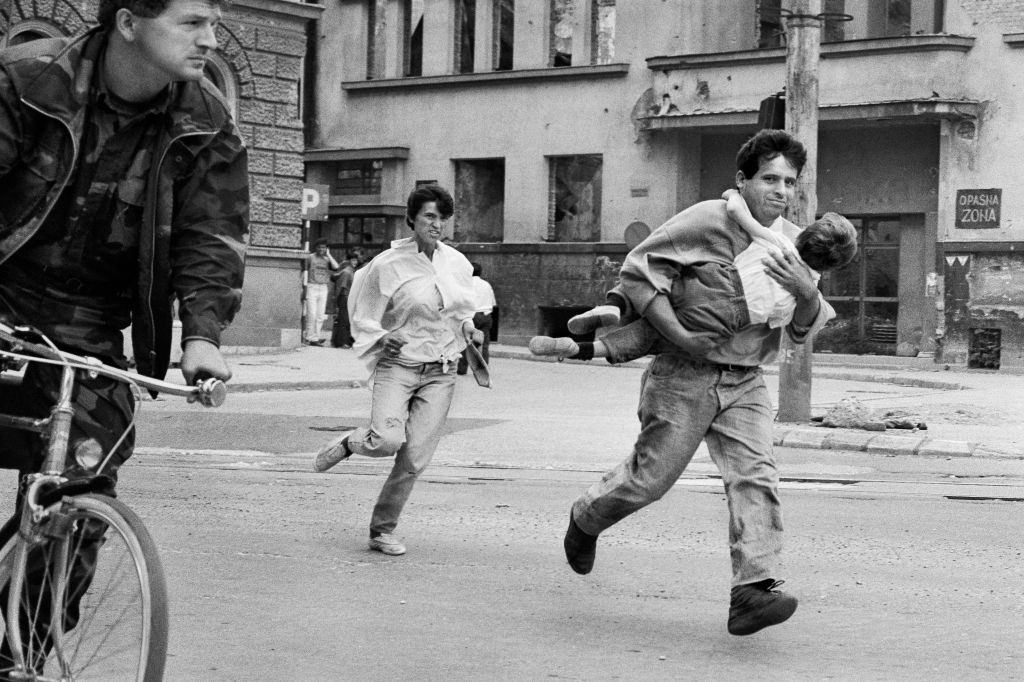
Mid-stride, a man bursts across an exposed Sarajevo street with a small child clutched tightly in his arms, his body angled forward as if sheer momentum might outrun the danger behind him. Just a few paces back, another civilian sprints with the same urgent focus, while at the edge of the frame a cyclist hesitates, half-turned and watchful. The surrounding façades—pocked, grimy, and stripped of everyday comfort—turn an ordinary city block into a corridor of risk.
“Sniper Alley” became a grim shorthand during the siege of Sarajevo, a name that distilled the daily calculation of whether to cross a road, fetch supplies, or simply move from one building to another. In 1994, civilians learned to read the street the way soldiers read a battlefield: the width of an intersection, the cover offered by a pole or doorway, the split-second timing of a dash. The photo’s power lies in its plainness—no uniforms, no front line—only family and neighbors moving through a war that invaded the routines of civilian life.
For readers exploring civil wars and urban warfare, this scene offers an unvarnished reminder of what siege conditions mean at street level: speed, improvisation, and the instinct to protect the most vulnerable. The child’s limp posture against the man’s shoulder suggests trust and exhaustion, while the adults’ strained expressions speak to fear managed through motion. It’s a stark, SEO-relevant window into the siege of Sarajevo, the reality behind the phrase “avoid gunfire,” and the human cost embedded in a single crossing.