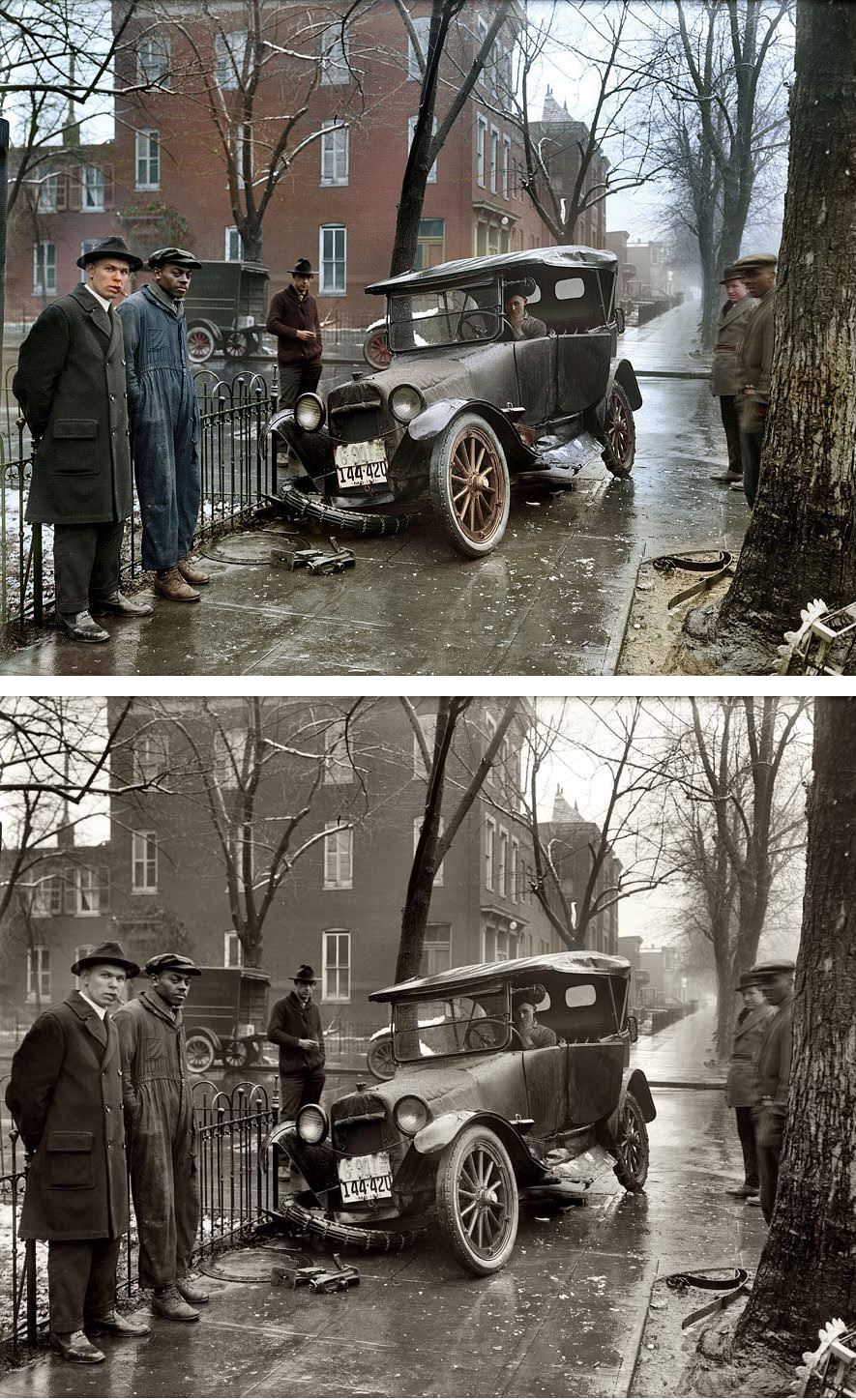
Winter light hangs over a Washington, D.C. neighborhood street as an early automobile sits awkwardly on the sidewalk, its front end crumpled and its body skewed toward a tree. The wet pavement reflects bare branches and brick rowhouses, giving the scene a cold, hushed clarity that makes the damage feel immediate. In the colorization, muted browns, grays, and iron-black details bring out the textures of mud, metal, and damp stone.
A small crowd gathers with the instinctive curiosity of any era—men in heavy coats and caps pausing to stare, one figure lingering near the wreck while another seems caught mid-step at the curb. The car’s bent fender and twisted bumper lie close to the ground, suggesting a hard jolt at low street speed rather than a high-speed chase. Even without dramatic chaos, the photograph conveys the everyday reality of the 1920s: cars were becoming common, while streets, sidewalks, and safety expectations were still catching up.
For anyone interested in Washington, D.C. history, early motoring, or the look of American city life in 1921, this image offers a candid glimpse into a transitional moment. The architecture and street trees frame the accident like a stage set, reminding us that traffic mishaps are not a modern invention—only the vehicles have changed. As a restored and colorized historical photo, it invites viewers to step closer to the ordinary drama of a century ago and imagine the conversations that followed once the camera was put away.