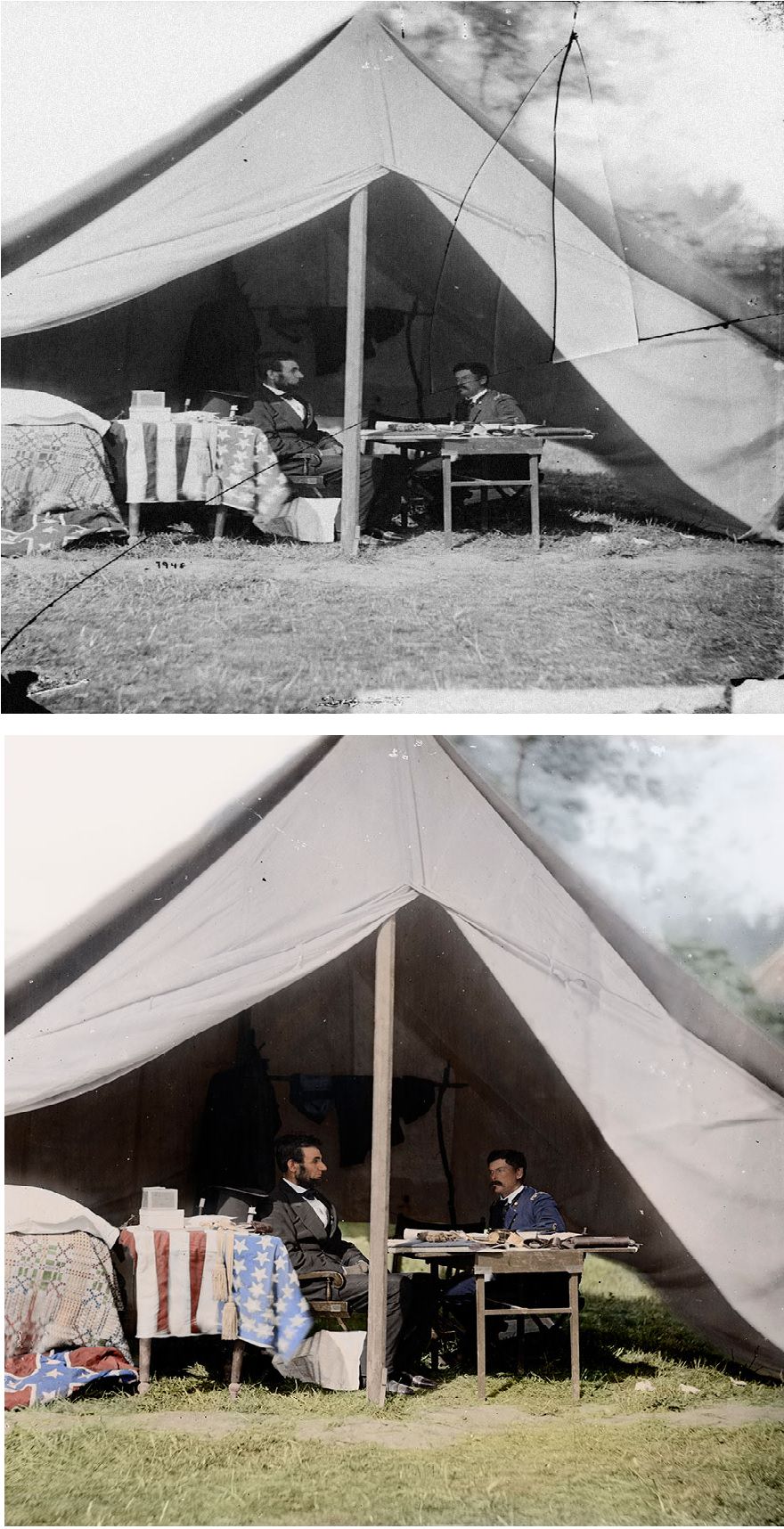
Under the broad canvas of a Union field tent, President Abraham Lincoln sits in quiet conversation with General George B. McClellan, a rare candid moment framed by campaign clutter. A simple table holds scattered papers and small objects, while a draped American flag and stacked boxes hint at the improvised routines of an army on the move. The scene feels informal yet charged, the kind of close-range encounter where national policy and battlefield reality could collide in a few measured sentences.
Antietam, Maryland—named in the title and long synonymous with the Civil War’s brutal turning point—hangs in the background even when the fighting is out of frame. Lincoln’s posture and familiar profile anchor the composition, while McClellan’s uniformed presence and attentive stance suggest the power dynamics of commander-in-chief and general at a critical moment. Details like the tent pole dividing the space and the open flap revealing daylight outside reinforce how thin the barrier could be between private counsel and public consequence.
The included colorization invites a fresh look at a famous portrait, restoring texture to cloth, grass, and uniform while keeping the documentary feel intact. For readers searching Civil War photography, Lincoln and McClellan at Antietam, or the portrait associated with the design of the Lincoln penny, this image bridges everyday material culture with enduring iconography. It’s a reminder that the face later pressed into coinage once leaned across a plain field table, negotiating the war in real time.