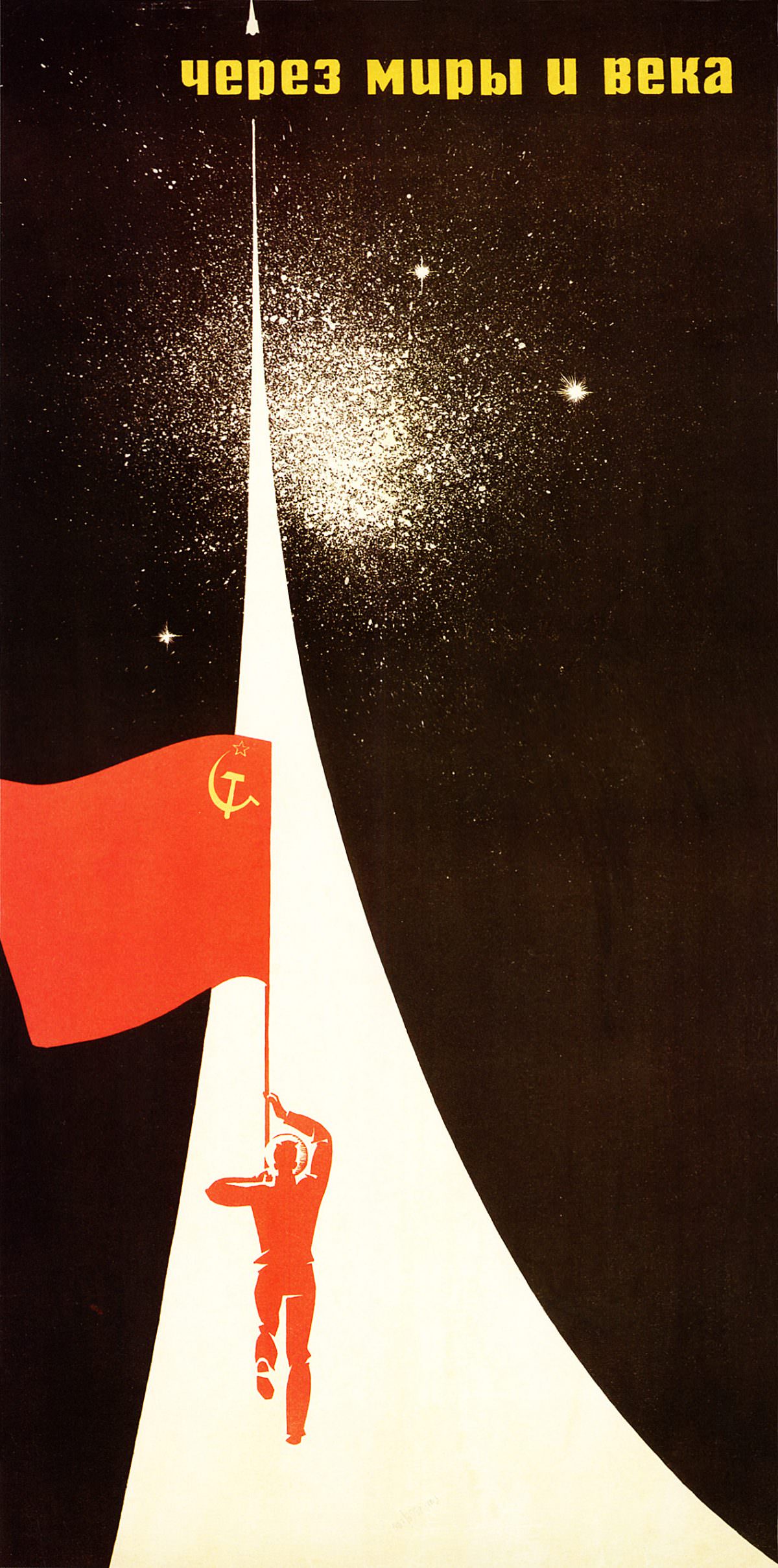
A bold sweep of white rises like a rocket’s trail into a dense, star-salted black sky, while the Cyrillic title “через миры и века” (“through worlds and ages”) glows overhead in warm yellow. At the base, a small red figure climbs and steadies a flag, the hammer-and-sickle emblem unmistakable against the flat field of crimson. The stark palette and clean geometry give the artwork a dramatic, poster-like energy that feels built for public walls and big ideas.
What lingers is the careful contrast between cosmic scale and human effort: a lone climber, simplified to a silhouette, reaches upward as if the future can be hauled into place by sheer will. The bright, granular starburst near the center suggests a galaxy or nebula, lending the scene a sense of scientific wonder even as the imagery reads as ideological. In that tension—between exploration and proclamation—the piece channels an era when space, modernity, and national ambition were woven into the same visual language.
For readers drawn to historical posters, Soviet-era graphic design, and the iconography of the Space Age, this image offers a striking example of how art could turn astronomy into narrative. Its minimal forms, high contrast, and propaganda aesthetics make it instantly legible even at a glance, while the title invites a longer meditation on time, distance, and destiny. “Through the worlds and ages” fits neatly within a gallery of artworks that use the cosmos as both setting and symbol, bridging history and imagination in a single frame.