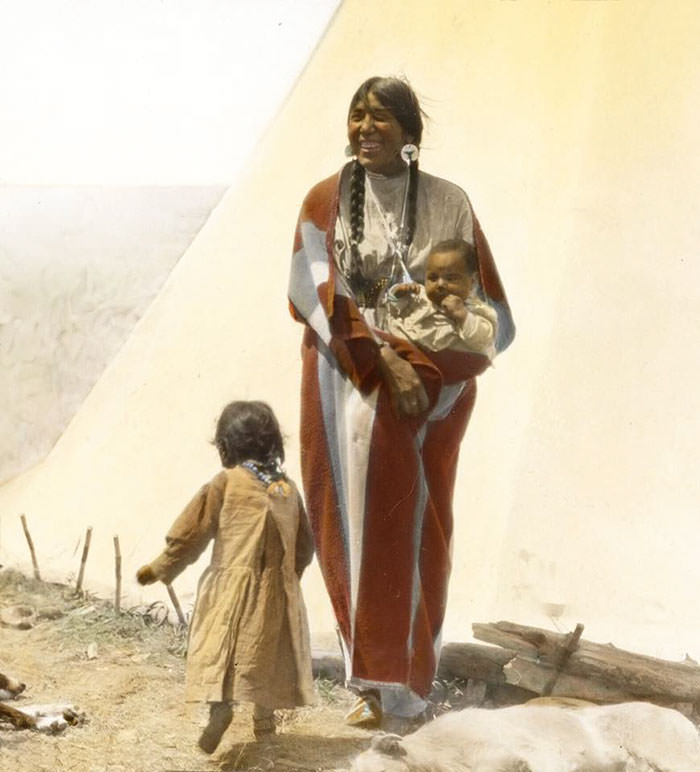
Movement gives “Coming Running” its pulse: a small child hurries across the foreground while a Blackfeet woman stands steady behind, holding a baby close against her chest. The open landscape and pale sky create a spare backdrop that draws the eye to everyday life—family, warmth, and the quick energy of children. A large light-colored canvas structure rises beside them, suggesting camp life on the Montana plains in the early 1900s.
Details matter in a lantern slide like this, especially with colorization bringing texture forward—braided hair, earrings that catch the light, and a patterned wrap or blanket draped around her shoulders. The baby’s round cheeks and the toddler’s loose dress lend the scene an intimate, domestic realism rather than a posed studio formality. Scattered boards and a few upright sticks in the ground hint at work and activity just outside the frame, the ordinary traces of a lived-in space.
As a piece of early 20th-century photography, this glass lantern slide bridges documentary record and personal moment, preserving a glimpse of Blackfeet family life in Montana without the stiffness often associated with period images. The title invites viewers to imagine the seconds before and after the shutter—who is being approached, what call sent the child forward, and how the day unfolded beyond the edge of the campsite. For readers interested in Native American history, Montana heritage, and colorized historical photos, this post offers a vivid, human-scale window into the past.