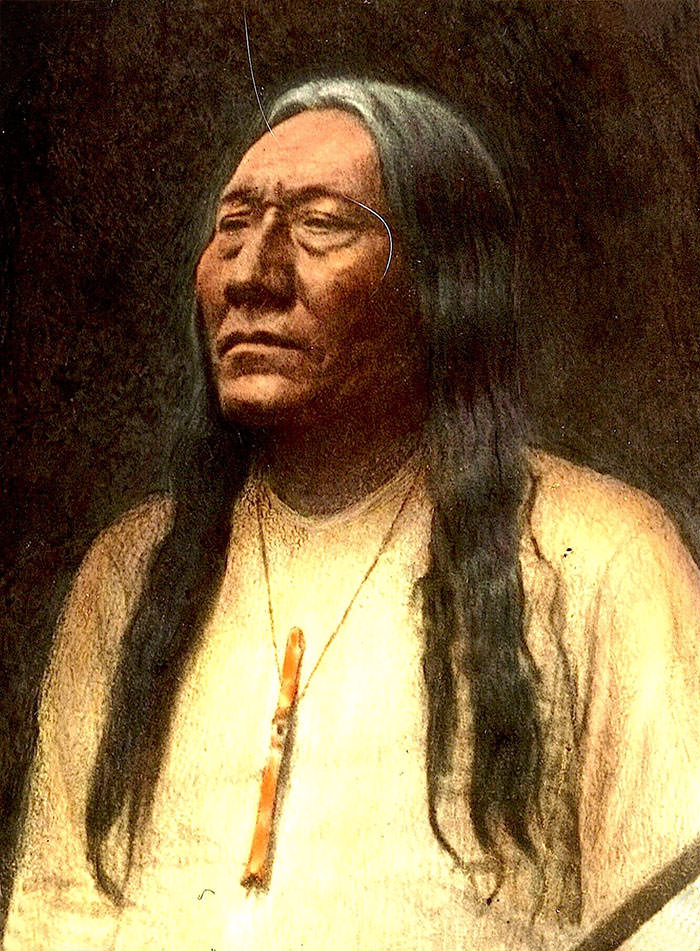
Chief Mad Wolf of the Blackfeet is presented here in a quiet, dignified portrait, his gaze turned slightly away as if fixed on something beyond the frame. Long, dark hair falls evenly over his shoulders, and the simple clothing and small pendant at his chest draw attention back to the strength of his expression—lined, thoughtful, and unyielding. The soft, dark background isolates the sitter, giving the face and profile a sculptural presence that feels both intimate and monumental.
Created as an early-1900s glass lantern slide by Walter McClintock, the image also reflects the era’s fascination with Indigenous life in Montana, filtered through a camera and a collector’s eye. Lantern slides were meant for projection, carrying photographs into lecture halls and parlors where audiences encountered the West as story and spectacle. In that format, details like skin tone, hair texture, and the subtle modeling of light on the cheekbones would have been central to how viewers remembered the subject.
The modern colorization adds another layer to the photograph’s long journey, inviting closer study while reminding us that color is an interpretive choice, not a recovered certainty. What remains constant is the portrait’s power as a historical record and a human encounter—one that encourages careful viewing and respectful context. For readers searching Blackfeet history, Montana photography, or Walter McClintock lantern slides, this post offers a compelling glimpse into early twentieth-century visual culture and the enduring presence of Chief Mad Wolf.